Welcome to the official website of Wuxi Shuangrui Machinery Co., Ltd!
Tel:0510-83451680
Most domestic pharmaceutical factories have never had a relatively complete and reliable connection and optimization in the production process of sterile active pharmaceutical ingredients as a whole. Especially in the transportation process of powdered pharmaceutical materials, there has never been a good connection of conveying methods in actual production. The conveying of such materials mostly adopts bulk material transportation or the use of material drums for transportation, and manual handling is carried out between unloading and repackaging processes. In this conveying method, materials usually need to pass through multiple purification rooms, and this process inevitably causes secondary pollution of the materials and product loss. In addition, during the production and preparation of some special chemical products, a complete set of processes including crystallization of the produced products, filtration, washing and drying are required. In terms of technology, it is necessary to avoid contact with air during these processes. If a fully enclosed conveying, filtering, washing and drying system is adopted, the above problems can be completely avoided, making the production process meet the special process requirements.
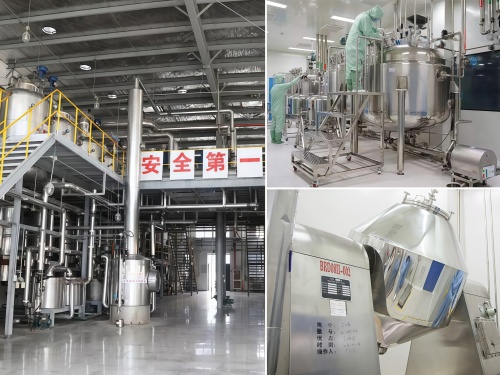
The three-in-one filtration, washing and drying system can complete the entire process from feeding to filtration, washing, drying and finally discharging in the same container continuously. It has the advantages of small equipment space occupation, high degree of automation and reduced labor intensity of personnel. It is widely used in solid-liquid separation, washing and drying in the pharmaceutical, chemical, food and pesticide industries.
The structure of the three-in-one filtration, washing and drying equipment
The three-in-one filtration, washing and drying system mainly consists of the vertical tank body of the pressure-bearing part, the heating system, the stirring system (stirring shaft, stirring paddle, mechanical seal, etc.), the stirring lifting mechanism, the transmission mechanism, the filtration medium, the discharge valve, the spray device, the sterilization device, the hydraulic pump station, the main electrical control cabinet (including frequency converter, CPU), and other components, achieving the integration of machinery, electricity and instrumentation.
After the basic operation processes such as filtration, washing, drying and solid unloading of a batch of materials are completed, the filtration, washing and drying machine can still use solvents to dissolve the materials that need further treatment and continuously carry out the next operation process. In production, to ensure that each step of the operation process of the filter washing and drying machine reaches the best, it is necessary to have a good understanding and mastery of the application characteristics and precautions during the use of the three-in-one process, so as to enable multiple process applications to be better completed continuously within the filter washing and drying machine.
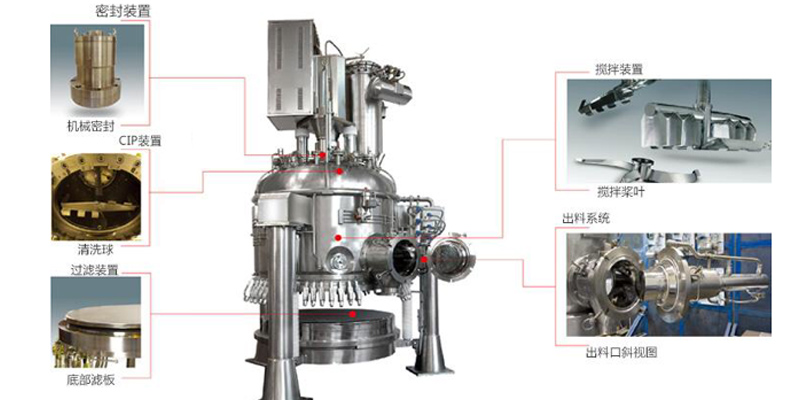
Performance features of the three-in-one filtration, washing and drying
(1) System sealing: The three-in-one system of filtration, washing and drying is a fully sealed system. Operating in a sealed system can prevent toxic substances from polluting the air and reduce the occurrence of poisoning accidents among operators.
(2) Recycling and utilization: Materials and solvents are almost completely recycled, avoiding waste caused by material omission and solvent evaporation, which brings significant economic benefits.
(3) Multi-functional integrated operation: Filtration, washing and drying are all completed in the same equipment. The container wall is equipped with a heating jacket layer, thus enabling drying treatment.
(4) Continuous operation: Filtration and drying are carried out in a continuous system without the need to handle wet filter cakes. The dried products can be mechanically conveyed to weighing, packaging and other sections.
(5) Save manpower: A non-technical person who has received simple training can complete the operation. Opening, closing, automatic feeding and automatic discharging do not require technical personnel to monitor.
(6) Thorough cleaning: The three-in-one filtration, washing and drying system is equipped with automatic spraying and stirring functions. The filter cake can be thoroughly cleaned, thereby reducing the amount of wastewater discharged and lowering the cost of wastewater treatment.
(7) Clean production: The multi-functional filtration and drying system is equipped with a dust collector to collect the dust generated after drying, which can meet the requirements of clean production.
Precautions for the production and use of the three-in-one filtration, washing and drying system
Precautions for pressure testing
The three-in-one filtration, washing and drying system should be tested for positive and negative pressure both before and after production use to ensure good air tightness of the tank before use. During the vacuum drying process of the powder in the filter washing and drying machine, the vacuum degree reaches above -0.085 MPa. To ensure the sterility of the powder in the tank, after sterilization, the equipment is tested for air tightness in accordance with the wet heat sterilization cabinet air tightness test standard (leakage rate not exceeding 1.3kPa/10 min). If the test is qualified, it can guarantee good air tightness of the equipment.
(2) Precautions for cleaning the trap
To ensure thorough cleaning, the soaking time starts from when water flows out of the reserved port of the trap each time, and it is necessary to ensure that water flows out of the reserved port continuously. Once there is no water flow, increase the water inflow and restart the timing. Before soaking the trap, the sintered plate must be preheated.
(3) Precautions for cleaning the discharge valve
Before removing the fastening screws of the discharge valve, the discharge door must be opened first. The fastening screws should be distinguished from the hinge screws. Before closing the discharge valve, the fastening screws must be tightened first and then the discharge door should be closed. Otherwise, it will cause major personal accidents and equipment accidents. When closing or opening the discharge valve, pay close attention and do not damage the sealing surface of the valve core.
(4) Precautions for cleaning sintered plates
Before cleaning with water for injection, the sintered plate must be preheated first; otherwise, it will be damaged. When cleaning the sintered plate after lowering it, a high-pressure nozzle should be connected to clean it along the grain, and the bottom valve should be closed at the same time. Before disassembling the filter plate, the pull rod screws need to be removed. Mark the space between the filter plate and the lower tank, then lift the filter plate and place it on a flat area protected by soft pads.
(5) Precautions during the drying process
When vacuum drying is carried out by opening the pneumatic butterfly valve, the balance valve should be opened in advance to ensure the pressure balance between the upper and lower parts of the sintered plate; otherwise, the sintered plate will be damaged.
When the material is not sticky during stirring, use a slow downward stirring method to loosen the filter cake. If there are sticky paddles or pilling phenomena, lift the stirring paddle, smooth the material evenly, and continue drying. The filter cake is relatively solid. It is strictly prohibited for the flat material to fall and scrape off the material, otherwise the sintered plate or mechanical seal will be damaged.
During the drying process, the rotational speed should mainly be slow. The paddles must not start in the material. Therefore, when starting or stopping the rotation of the paddles, they must be detached from the material; otherwise, the motor, reducer or mechanical seal will be damaged.
⑤ Pay attention to descending slowly and do not overdo it; otherwise, the stirring paddle may shift and damage the mechanical seal.
(5) Precautions for abnormal power outages in the workshop
When the three-in-one filtration, washing and drying equipment leaves the factory, the balance ball tube of the equipment is connected to the rear end of the pneumatic butterfly valve on the vacuum pipeline. When sterilizing this equipment, the butterfly valve of the vacuum pipeline and the vacuum ball valve on the balance ball pipe are closed. Therefore, only the pipeline from the front end of the pneumatic butterfly valve to the collector end and the pipeline at the lower end of the vacuum ball valve can be ensured to be sterile. During the vacuum drying process of the bacteria-free powder, to protect the pressure balance of the sintered plate, the vacuum of the balance ball tube and the main pipeline at the upper end of the collector are both opened.
When there is an abnormal power outage in the workshop, the pneumatic butterfly valve of the vacuum pipeline at the upper end of the collector will automatically close, while the vacuum ball valve needs to be manually closed. Therefore, there is a risk of the equipment inhaling bacterial gas. The workshop has added a new pipeline from the lower end of the vacuum ball valve on the balance ball pipe to the front end of the vacuum butterfly valve on the main pipeline. When the vacuum butterfly valve on the main pipeline is opened, the newly added pipeline valve is opened and the vacuum ball valve is closed. This can ensure that in case of abnormal power outage, the equipment will suck in the gas containing bacteria.
(6) Precautions for online sterilization
Before sterilizing the filtration, washing and drying machine, steam purging should be carried out on the tank and connecting pipelines. The temperature should be controlled to change slowly, avoiding sudden heating and cooling, and preventing irreversible deformation or damage to the equipment due to severe cold expansion and contraction. During the online sterilization verification of the equipment, it was found that the spray ring pipe and the tank body should be sterilized separately; otherwise, air resistance is likely to form in the spray ring pipe during the sterilization process, resulting in incomplete sterilization. When sweeping the upward dead corners of the equipment pipeline, all non-condensable gases must be fully discharged to ensure the sterilization effect of the pipeline during subsequent sterilization.
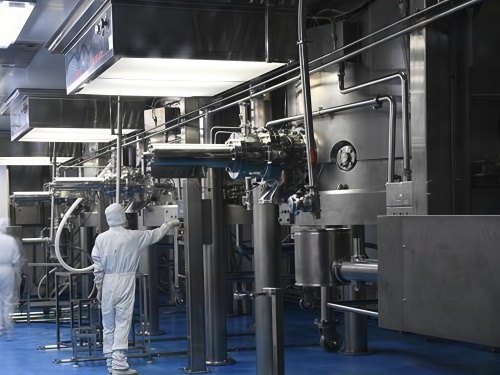
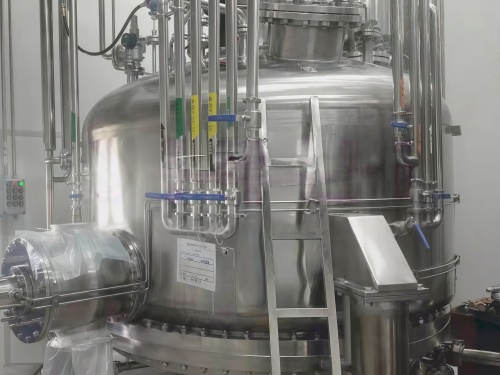

We provide design, research and development, production, and technical services for crystal filtration, washing, and drying equipment, and are committed to undertaking refining and purification projects for fine chemicals, pharmaceuticals and their intermediates, flammable, explosive, and highly toxic special chemicals.
Welcome to contact us!
Tel:13861731823

 备案号:备案号:苏ICP123456789


