Welcome to the official website of Wuxi Shuangrui Machinery Co., Ltd!
Tel:0510-83451680
In the production of active pharmaceutical ingredients (apis), most of the crystallized materials need to go through separation, drying and mixing. This process is commonly used in the production of apis. Solid substances are first separated from the suspension by filtration. The next process will continue to be refined in the form of vacuum or heating drying. The classic equipment used in this process production is the single-cone vacuum dryer, which integrates mixing and vacuum drying and is widely applied as a classic device due to its simplicity, convenience and high efficiency. In terms of its practicality and economy, It is irreplaceable by other devices.
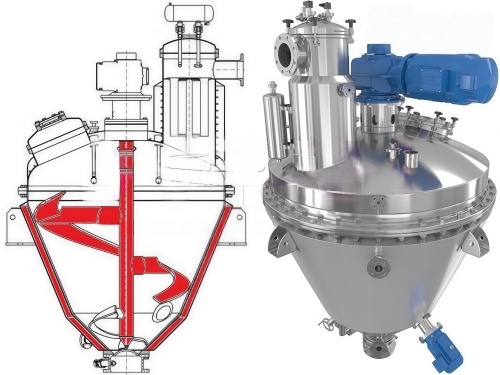
The single-cone vacuum dryer is a multi-functional dryer that integrates mixing and vacuum drying. The materials are heated and stirred simultaneously inside the tank. The moisture evaporated due to heating is extracted by a vacuum pump, and the dried materials are discharged from the bottom outlet of the cone. The single-cone dryer features high drying efficiency, a large drying contact surface, rapid and thorough material discharge without dead corners, and is also relatively easy to clean. It can simultaneously replace both mixing and drying equipment (such as double-cone dryers, paddle dryers, double-cone mixers and twin-screw mixers, etc.) to complete the entire process of mixing, drying and discharging in the same device. It can also perform operations such as cooling, sterilization and reaction. It can be widely applied in industries such as medicine, chemical engineering, pesticides, and food. It is an excellent device for mixing and drying, capable of achieving fully enclosed and continuous operation throughout the entire process. This dryer can be used for drying heat-sensitive, easily oxidized, flammable and solvent-containing crystalline or granular materials. However, when used for drying some viscous and heat-sensitive crystalline materials, agglomeration may occur.
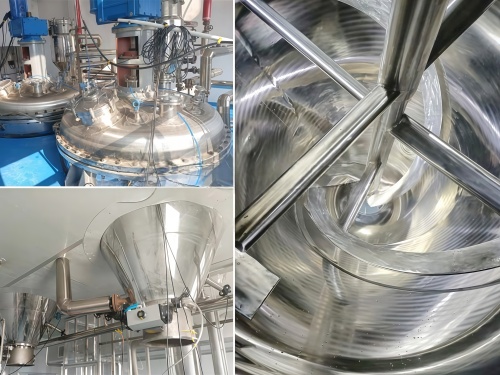
To address the issue of agglomeration during the drying of vitamin C-type raw materials by single-cone vacuum dryers, Wuxi Shuangrui used vitamin C as the test material and adopted the DLG-120 single-cone vacuum dryer prototype. By controlling the temperature of hot water and variable frequency speed regulation, the influence of temperature and speed on the drying rate was studied, and the causes and solutions of material agglomeration were explored. The specific research methods are as follows:
(1) Study the drying conditions of wet materials with different moisture contents and find the maximum moisture content that does not form lumps (here, "not forming lumps" means that the material being dried does not form new lumps during the drying process).
(2) At a certain set hot water temperature, study the influence of rotational speed (achieved through variable frequency speed regulation) on the drying rate and the state of the material;
(3) At a certain set rotational speed, study the influence of hot water temperature on the drying rate and the state of the material.
Experimental results on the drying of active pharmaceutical ingredients by temperature and rotational speed of single-cone vacuum dryer
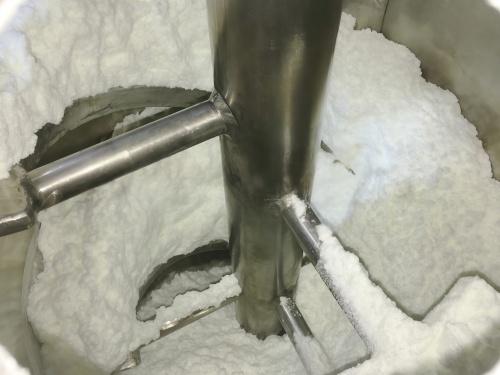
(1) The higher the moisture content of viscous materials, the more difficult it is to dry, and the more likely they are to form lumps during drying. If it is to be controlled from clumping, the drying time will have to be greatly increased, but this is extremely uneconomical in production.
(2) For viscous paste-like materials like vitamin C, the maximum moisture content that can be controlled without agglomeration when drying with a single-cone vacuum dryer is 40%. Moreover, since the surface of the material does not scatter after drying, it hinders the diffusion of internal moisture to the surface layer, prolongs the drying time, and at the same time, the drying effect is also affected.
(3) When the temperature of hot water is constant, the drying rate increases with the increase of rotational speed. However, in the later stage of drying, as the moisture content of the material decreases, the drying rate also drops. At this point, increasing the rotational speed is of no benefit to improving the drying rate. Therefore, the rotational speed should be increased when there is no agglomeration (the surface is relatively dry) to accelerate the drying rate and shorten the drying time.
(4) When the rotational speed is constant, the drying rate increases with the rise of hot water temperature, but the increasing trend is not obvious when the hot water temperature is relatively low (below 50℃). Therefore, for heat-sensitive materials, it is advisable to select the drying temperature between 50 and 60 degrees Celsius. This way, a certain drying rate can be achieved without damaging the materials.
(5) When the temperature of the hot water is too high (>60℃) and the rotational speed is relatively fast at the initial stage of drying, a large amount of moisture evaporates from the surface of the material. The steam cannot be removed in time, so the surface of the material is very wet and prone to sticking into lumps.
When using a single-cone vacuum dryer to dry materials, the material clumps up because at the initial stage of drying, the evaporation of water is too large. The steam that is not removed in time condenses on the top cover of the double-cone and drips, causing the material to clump together. By means of variable frequency speed regulation and control of the drying temperature, that is, keeping the rotational speed lower and the hot water temperature lower at the initial stage of drying, the evaporation of water can be reduced and the steam can be removed in a timely and sufficient manner, thus avoiding the agglomeration of materials. However, as the moisture content of the material decreases, the rotational speed and hot water temperature should be gradually increased to enhance the drying rate, thereby achieving the desired drying effect.
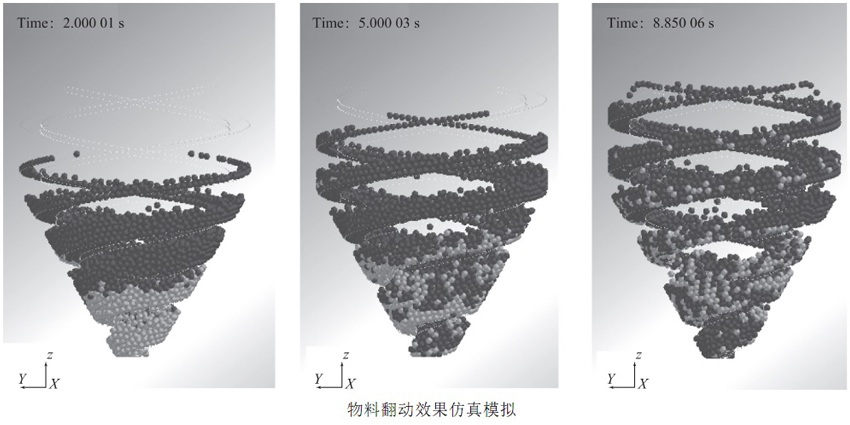

We provide design, research and development, production, and technical services for crystal filtration, washing, and drying equipment, and are committed to undertaking refining and purification projects for fine chemicals, pharmaceuticals and their intermediates, flammable, explosive, and highly toxic special chemicals.
Welcome to contact us!
Tel:13861731823

 备案号:备案号:苏ICP123456789


