Welcome to the official website of Wuxi Shuangrui Machinery Co., Ltd!
Tel:0510-83451680
In the post-treatment processes of the production of pharmaceuticals, pesticides, explosives, dyes, pigments and other fine chemicals, there are often unit operations such as filtration, washing and drying. These unit operations are usually operated independently by unit equipment such as centrifugal filters, washing tanks and dryers, and materials are conveyed between the equipment through pipelines or other means. Large-scale devices with multiple unit equipment connected into a system, long processes, low efficiency and difficult-to-regulate production processes, for suspensions with high solid content, often cause solid adhesion to the wall and blockage of pipelines, making normal production difficult. Although open production is convenient for dealing with clogging problems, it is difficult to meet the specification requirements for pharmaceuticals, food, biological products, etc. Moreover, for flammable, explosive, toxic or highly toxic materials, there are also safety hazards.
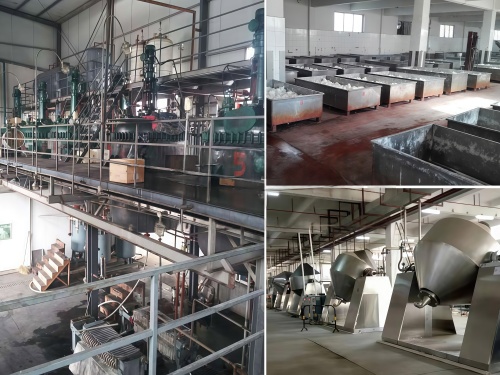
In order to overcome the problems and deficiencies existing in the above-mentioned unit equipment combination and meet the transformation of the chemical industry towards high quality, high added value, multiple varieties and small batches, our company has carried out a large amount of design and research and development work. Finally, we have successfully developed a multi-functional cylinder-cone reaction filtration and drying machine integrating filtration, washing and drying, achieving a significant improvement in the technical performance of the equipment. From structural design to application, it closely follows the corresponding regulatory requirements of the pharmaceutical industry. This equipment has three main functions: filtration, washing and drying. It also has multiple functions such as reaction, extraction, crystallization, concentration, evaporation, mixing and crushing. It is a high-tech device and has the following advantages:
(1) Closed operation, with multiple process procedures completed within the same equipment, reduces the impact of dust and microorganisms on material quality, minimizes the loss of valuable materials, and thereby enhances product quality and output.
(2) Reduce the material conveying links, especially the conveying of filter cakes, shorten the production cycle and enhance production capacity.
(3) Filtration and washing operations can be carried out under vacuum or pressure, and the process operation is flexible and easy to control.
(4) For the handling of flammable, explosive, toxic or highly toxic dangerous goods, reduce environmental pollution, improve the working environment and ensure operational safety.
(5) Short processes, reduced equipment, less factory space, and lower engineering investment.
Introduction to the Flat-plate Filtration, Washing and Drying Three-in-One Equipment
A transmission device is installed on the top of the tank, and the rotational speed, forward rotation or reverse rotation is controlled by a variable frequency motor. The tank is equipped with a stirring paddle that is hydraulically controlled for lifting and lowering. The stirring shaft and the stirring paddle can be made into a hollow structure, and a heat medium can be introduced to enhance heat transfer during drying. The tank is horizontally equipped with filter plates - filter beds, which divide the tank into upper and lower compartments. Materials and inert gases are added to the upper compartment, while the lower compartment is evacuated to create a pressure difference between the top and bottom, thereby accelerating the filtration rate. There are heating (cooling) jackets or coils on the outside of the tank and under the filter plate. A discharge port is provided at the lower side of the upper compartment, which is connected to a plug type discharge valve. The bottom of the tank - the chassis can be raised and lowered by hydraulic control during disassembly.
Filtration - Top feeding, filtrate discharged from the bottom; Washing - The tank is equipped with a specially designed spray device, which enables the cleaning (washing) liquid to evenly wash away the impurities adhering to the surface of the grains. Drying - Heating steam enters from the side wall jacket, condensate water is discharged from the bottom coil, the agitator stirs the material, and the upper part is evacuated. A bag separator is installed at the vacuum port. When unloading - Open the discharge valve and the material will be pushed out by the stirring paddle.
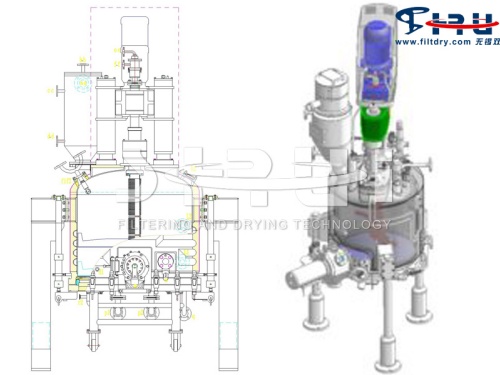
Introduction to the Cylindrical and Conical Reaction Filtration Dryer Equipment
The structure of the fixed cylindrical conical filter dryer is shown in the figure. The upper part is cylindrical and the lower part is conical, so it is called cylindrical conical. Both the upper cylinder and the lower cone are of double-layer jacket structure: the inner jacket serves as the filtrate channel, with small holes opened on the inner wall. On the inner side of the inner wall, there are filter cloth and filter screen (composite perforated plate screen) in sequence. The filtrate passes through the filter screen, filter cloth and the inner wall of the inner jacket first and then enters the inner jacket, and then flows out through the filtrate outlet. The outer jacket serves as a channel for hot or cold media, used for heating or cooling. The drive device is installed on the top of the container, and the spiral scraper, stirring paddle and pushing screw are installed on the middle transmission shaft of the equipment. The drive device can rotate forward or backward to lift or push the materials up or down.
As an improved version of the vertical fixed cylindrical conical filter dryer, the lower part of the rotating shaft and the helical ribbon are made hollow to pass cold or hot media, thereby enhancing heat transfer.
Specific operation process: Feeding - First, add the materials into the equipment through the top feeding port; Filtration - Open the filtrate outlet and filter the material by vacuuming at the filtrate outlet or applying compressed air at the top of the equipment. Washing - Pause the filtration. Add the washing solvent from the top and wash under stirring. After washing, continue the filtration operation. Drying - Heat medium is introduced into all the hollow rotating parts and the outer jacket mentioned above to heat the material. At the same time, a vacuum is created at the top of the equipment to perform vacuum drying on the material. Unloading - Open the quick-opening discharge valve at the bottom to make the drive mechanism rotate in the opposite direction. The push screw will automatically push the dried material out of the machine.
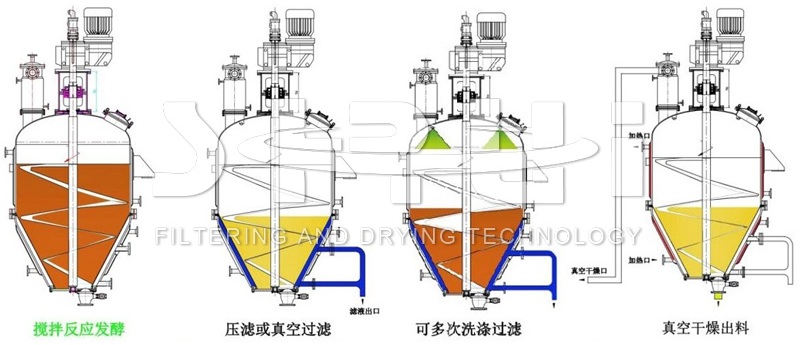
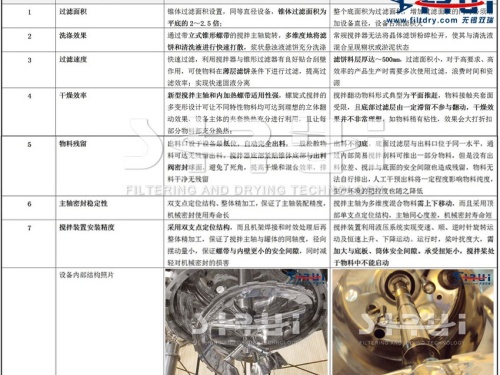
The multi-functional cylinder-cone reaction filtration dryer adopts a fully enclosed structure and intermittent operation mode. It uses vacuum filtration and heating drying to remove solvents. It is particularly suitable for processing flammable, explosive, toxic or highly toxic dangerous products, valuable products, as well as fresh and delicious foods, biological products and medicines that are not allowed to be contaminated
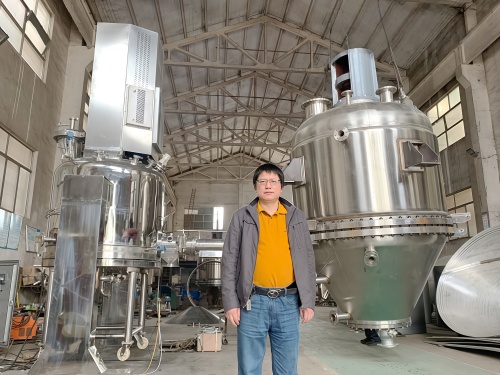

We provide design, research and development, production, and technical services for crystal filtration, washing, and drying equipment, and are committed to undertaking refining and purification projects for fine chemicals, pharmaceuticals and their intermediates, flammable, explosive, and highly toxic special chemicals.
Welcome to contact us!
Tel:13861731823

 备案号:备案号:苏ICP123456789


