Welcome to the official website of Wuxi Shuangrui Machinery Co., Ltd!
Tel:0510-83451680
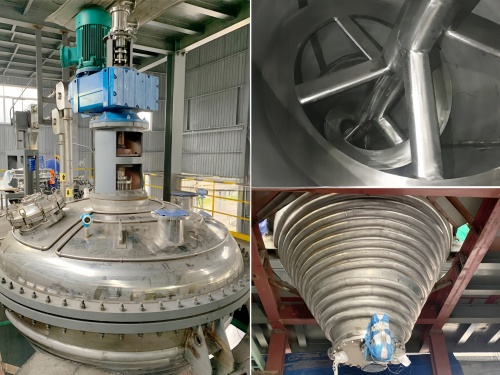
After a certain enterprise in Sichuan purchased a special dryer for the new herbicide glufosinate-ammonium and successfully put it into operation, it rapidly spread and fermented in the agrochemical industry. Many pesticide enterprises came to visit out of admiration. After long-term and repeated investigations and experimental verifications, they finally settled on Shuangrui Machinery alone. The single-cone vacuum dryer (Patent No. : ZL 2020 2 3230599.8, 2021 1 1275944.6) and the conical filtration, washing and drying integrated machine (Patent No. :) developed and manufactured by Wuxi Srui ZL 201721560677.6, ZL 202023247813.0, ZL 202220572661.1 are respectively used for the drying of insecticides and the refining and purification of pharmaceutical intermediates, aiming to enhance production efficiency, improve the working environment, eliminate backward processes, and gradually achieve automation. And achieve the maximization of resource utilization and compliance with emission standards.
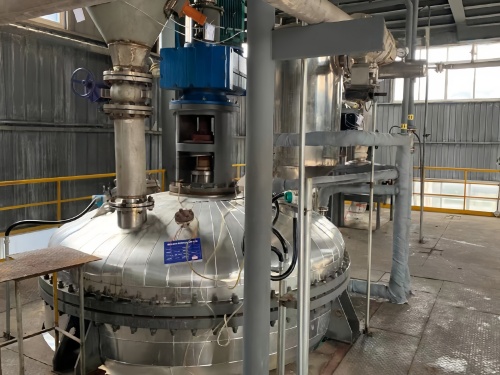
In the production of the organophosphorus herbicide glufosinate-ammonium, the drying operation unit determines the moisture content of the finished pesticide active ingredient and has a certain impact on the crystal structure. It is an important process. Whether the drying equipment can be correctly selected is directly related to the quality of the product, the operating environment and the production cost. At present, the commonly used drying equipment for solvent-based herbicides includes double-cone rotary vacuum dryers, paddle vacuum dryers, vacuum disc dryers, single-cone vacuum dryers, etc.
(1) Paddle vacuum dryer
The paddle vacuum dryer is mainly composed of the cylinder, stirring shaft, transmission system and sealing device, etc. The heat required for drying is mainly provided by the stirring shaft and the jacket of the cylinder. When the heating medium is introduced into the equipment, the heat indirectly heats the material through the jacket and the stirring shaft. The moisture in the wet material vaporizes due to heat, and the vaporized moisture is promptly removed by the vacuum system. As the stirring shaft keeps rotating, the contact between the material and the heating surface is constantly renewed, ensuring uniform heating of the material and thus achieving a good drying effect.
The vacuum paddle dryer applied to the organophosphorus herbicide glufosinate-ammonium has the following problems: uneven moisture content of the product and yellowish color. Moreover, it is extremely prone to sticking to the wall and cannot be produced continuously. Among them, the organic solvent methanol is an important reaction raw material and also a highly flammable and explosive toxic substance. There are strict recovery requirements in the process.
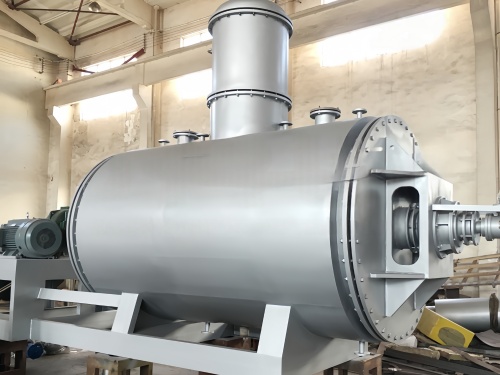
(2) Vacuum disc dryer
Vacuum disc dryers are suitable for drying heat-sensitive materials with very low drying temperature requirements. Wet materials are added in batches to the negative pressure-resistant quantitative feeder. After the vacuum pump is turned on to make the disc dryer in a negative pressure state, the materials are evenly added to the dryer through the continuous lock for drying operation. The dried materials are discharged from the discharge port at the bottom of the dryer. The moisture escaping from the material is recovered through the condenser and the solvent receiving tank, and the entire operation process is carried out under negative pressure. The vacuum disc dryer applied to the organophosphorus herbicide glufosinate-ammonium has the following problems:
The problem of material overflow from the large plate of the disc dryer is serious
When the drying processing volume is large, the outer rake knife cannot quickly remove the wet material.
② There is no fabric tray set on the upper layer.
③ The number of rake rods on the upper two large plates is small, and the type of the outer rake knife is incorrect, which is prone to warping.
④ Wet materials have a relatively high moisture content, are slightly sticky, and have poor fluidity.
Ii. Deformation and Angle issues of the rake rod and rake leaf of the disc dryer
① The number of rake rods is small, and the diameter and fixation method of the rake rods need to be improved.
② The rake leaves are deformed. The type of the rake ears, the weight of the rake blades, and the fixation method between the rake blades and the rake ears need to be improved.
③ Rake Angle issue: Factors such as the length, Angle, arrangement of the rake, and the thickness of the material spread on the disc surface need to be comprehensively considered.
Iii. Problems of material adhesion to the heating tubes of the disc dryer and the outer wall of the disc dryer (Common problems of disc dryers)
① Accumulation of materials on the reverse side of the heating plate and on the rake rod: unsolvable;
② Accumulation of materials on the heat source inlet and outlet pipes of the heating tube: This can be partially solved.
③ Material accumulation on the inner wall of the cylinder and the upper cover of the disc dryer: can be partially solved.
Ⅳ. The problem of long-term material storage on the outer fence of the plate surface
The roundness tolerance of the outer enclosure of the heating plate is large.
② The concentricity of the heating plate installation is low
③ The welding process of the heating jacket is incorrect, resulting in an uneven upper plate surface and material accumulation.
④ The type of the outer rake knife is incorrect, which is prone to warping.
V. The problem of material caking and pilling
① Wet materials have a relatively high moisture content, are slightly sticky, and have poor fluidity.
② Materials accumulate on the tray surface;
③ Issues regarding the process setting and control accuracy of the heating temperature of the heating plate;
Vi. The disc dryer needs to be cleaned regularly by personnel or with tools
① The disc dryer has many moving parts. One device has hundreds of rake rods and thousands of rake knives, which are prone to malfunction.
② The disc dryer accumulates a lot of material. The reverse side of the heating disc, the rake rod, the heat source inlet and outlet pipes of the heating tube, the inner wall of the cylinder and the upper cover are all prone to material accumulation.
③ The disc dryer has high process requirements for wet materials, which must be free-flowing and non-sticky powders.
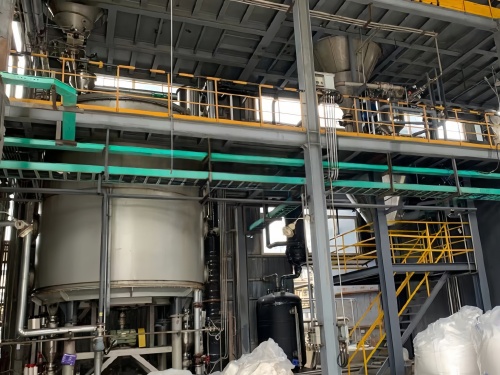
(3) Single-cone vacuum dryer
The single-cone dryer is a derivative of the conical mixer. On the basis of the original single mixing function, it introduces a drying function (by adding a heating jacket outside the original conical cylinder), which can dry the material while stirring, achieving a dual-function effect with one machine. It can not only be used for drying heat-sensitive materials It can also be used for the mixing, reaction and drying of powder and powder, powder and liquid. This machine can effectively solve the problems of long working hours, low efficiency, high noise, easy caking, multiple leakage points, difficult maintenance, and inconvenient operation and cleaning of traditional drying equipment. It is a high-efficiency drying equipment with low unit energy consumption, high efficiency and good effect among similar domestic and foreign equipment currently used in the industry, and can be widely promoted in the pharmaceutical, chemical, pesticide, food and other industries.
The single-cone vacuum dryer has no transmission mechanism inside the cylinder, fundamentally eliminating material contamination caused by lubrication leakage. It operates reliably and stably, and is particularly suitable for the mixing of powder and granular materials with high hygiene requirements. It is also suitable for the stirring and mixing of viscous fluids or materials mainly in the form of thick, wet or paste. The agitator of this machine is composed of a stirring main shaft and two helical belts and helical blades that fit the inner wall surface of the cylinder. When rotating, the helical ribbon and helical blades lift the material from bottom to top along the inner wall of the cylinder in a spiral manner. At the same time, due to the different linear velocities at each point on the helical ribbon surface during operation, the material undergoes irregular convection, shearing, mixing and diffusion under its action, forming a three-dimensional motion in all directions. The center of the stirring shaft is the helical blade. During operation, the material near the center is lifted and thrown out. Part of the thrown material enters the helical ribbon, while the material thrown out by the helical ribbon is absorbed into the helical envelope of the helical blade and lifted. This continuous and repeated cycle enables the materials to achieve uniform mixing in a short period of time.
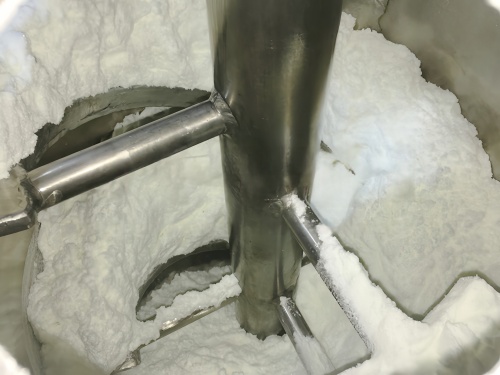
Technical features of glufosinate-ammonium single cone vacuum dryer
Due to its low pressure, combined indirect heating and unique helical ribbon structure, the single-cone vacuum dryer has the following significant advantages compared with traditional dryers:
(1) High efficiency and good quality: The single-cone vacuum dryer uses a combination of jacket and helical ribbon heating for the material, effectively extending the drying time. At the same time, this heating method effectively prevents the material from being contaminated by the heat source during the drying process.
(2) Low energy consumption: The conical cylinder of the compound heating dryer remains stationary, and the materials inside the dryer are stirred by the screw ribbon, thereby reducing the energy consumption of the drive.
(3) Avoid clogging: As the cylinder of the compound heating dryer remains stationary and the vacuum port is located on the end cover of the dryer, the material cannot move to the vacuum port, thus avoiding clogging.
(4) Uniform heating: During the drying process of materials, due to the structural characteristics of the helical ribbon, it can enhance the mixing efficiency of high-temperature and low-temperature materials, and achieve uniform heating through heat transfer between materials.
Today's quality, tomorrow's market. Wuxi Sunray constantly pursues the high performance and stability of its equipment. With mature and advanced technology and a mindset of anticipating customers' concerns, it remains calm and composed, forging ahead with vigor on the path of innovation and research and development, providing customers with practical technical solutions. The love and trust that our customers have for Shuangrui Machinery are the continuous driving force on our path of growth!

We provide design, research and development, production, and technical services for crystal filtration, washing, and drying equipment, and are committed to undertaking refining and purification projects for fine chemicals, pharmaceuticals and their intermediates, flammable, explosive, and highly toxic special chemicals.
Welcome to contact us!
Tel:13861731823

 备案号:备案号:苏ICP123456789


