Welcome to the official website of Wuxi Shuangrui Machinery Co., Ltd!
Tel:0510-83451680
At present, the main process for the post-treatment of crude silver powder in China is ammonia leaching to separate silver, followed by reduction and silver precipitation with hydrazine hydrate. During the reduction process, a large amount of ammonia gas is generated and dissolved in the silver precipitation solution. The use of traditional filter presses, due to their openness, leads to a large amount of ammonia gas being discharged into the air, polluting the on-site production environment and causing environmental protection problems. At the same time, the sealing performance of traditional plate and frame filter presses is relatively poor. The effect of air-blowing drying is limited, resulting in a high moisture content in the crude silver powder, which is not conducive to the subsequent converter production. Therefore, how to reduce the ammonia gas emission during the filtration process and simultaneously lower the moisture content in the crude silver powder has become a key issue that needs to be addressed.
In order to meet the increasingly strict environmental protection requirements for the post-treatment production of crude silver powder, Wuxi Shuangrui has developed and designed a new type of integrated filtration, washing and drying machine, which replaces the existing plate and frame filter press to carry out the filtration, washing and drying operations of crude silver powder. After a period of trial operation, the application practice in actual production has proved that the new three-in-one equipment can significantly reduce the on-site ammonia gas concentration and achieve good results.
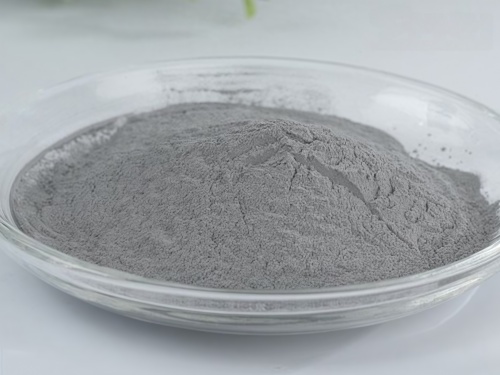
Overview and Working Principle of the Crude Silver Powder purification, Filtration, Washing and drying Machine
The filtration, washing and drying machine (commonly known as "three-in-one" in the industry) can achieve continuous processes such as filtration, washing, drying, sterilization and unloading of materials. Its operation mode belongs to batch operation (intermittent operation), and it is widely used in the pharmaceutical, food, pesticide, chemical and other fields, which can avoid material loss, contamination and environmental pollution that may be caused during the transfer of materials. The current three-in-one structure is flat plate type, but some defects have been found in long-term production and use, such as: the circular flat bottom has a small filtration area; Side discharge leads to incomplete discharge. The drying effect is not ideal. During the drying process, the material flips slightly, the heat exchange efficiency is low, and the drying effect is restricted, etc.
In order to overcome the problems and deficiencies existing in the above-mentioned unit equipment combination and meet the transformation of the chemical industry towards high quality, high added value, multiple varieties and small batches, our company has carried out a large amount of design and research and development work, and finally successfully developed a conical three-in-one multi-functional equipment integrating filtration, washing and drying. And it successfully applied for a patent (patent number: ZL202022908020.2, ZL202022906527.4), achieving a significant improvement in the technical performance of the equipment. From structural design to application, it closely follows the corresponding regulatory requirements of the pharmaceutical industry. This equipment has three main functions: filtration, washing and drying. It also has multiple functions such as reaction, extraction, crystallization, concentration, evaporation, mixing and crushing. It is an improved multi-functional device.
The new type of filtration, washing and drying machine adopts a cylindrical and conical structure. Heating jackets are set on the cylindrical body and the lower conical body, which can heat or cool the materials. Inside the multi-functional machine, there are hollow shafts and variable-angle and variable-lead hollow spiral stirring devices for stirring and lifting the materials, and the materials are pushed out when discharging. A relatively complex conical filtering device is set in the lower cone. At the bottom of the equipment, there is a specially designed quick discharge device without dead corners or a pneumatic discharge ball valve without dead corners.
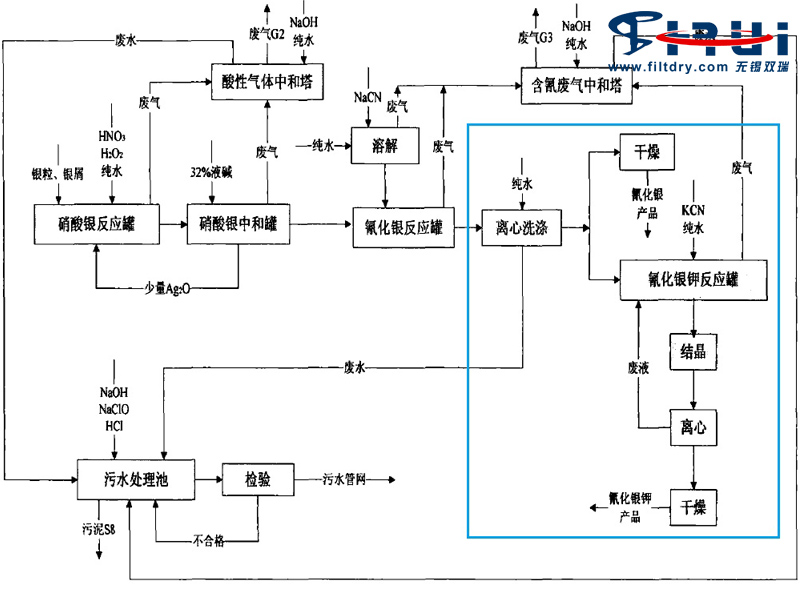
Production practice and Existing Problems of Crude Silver powder purification, filtration, washing and drying machine
Wuxi Srui has designed an integrated filtration, washing and drying machine, which mainly consists of a transmission device, lifting device, mechanical seal, manhole, tank body, stirring system, discharge valve device, outriggers, etc. Its working principle is to use high-pressure nitrogen to generate positive pressure inside the tank, thereby achieving solid-liquid separation. The entire process from feeding to filtration, washing, drying and finally discharging can be continuously operated in the same container.
As the new type of three-in-one washing, filtering and drying equipment is applied in the post-treatment production of metallurgical crude silver powder, there is no ready-made experience to refer to during the design process. Moreover, the application of this equipment in the metallurgical industry is extremely rare. At the same time, since the factory building has already been completed and the equipment will be purchased and installed later, it is subject to various restrictions such as the site. Therefore, there are certain flaws in the design. At the same time, after a period of trial operation, some existing problems were also exposed. The trial operation practice process is briefly described as follows:
Phase One After feeding and filtering the materials from the first reactor - the silver immersion reactor, it was observed inside the integrated machine that silver powder occupied approximately one-third of the volume. To simplify the operation process, the materials from the second reactor - the silver immersion reactor were added and the subsequent steps continued. When discharging the materials, it was found that the resistance encountered by the stirring paddle was relatively large, and the ammonia smell on site was strong after discharging, indicating that the washing effect was poor. It is not advisable to simultaneously feed the silver bath solution into two reaction vessels. Instead, feed the silver bath solution into one reaction vessel each time, and after the treatment is completed, feed it into the second vessel.
Phase Two After several test runs, it was found that the feeding speed was getting slower and slower. After inspecting the reaction vessel, it was discovered that silver powder had deposited at the bottom of the silver deposition reaction vessel, causing the discharge port of the reaction vessel to be blocked and a large amount of silver powder to accumulate subsequently. The silver powder could not enter the integrated machine by gravity flow. Therefore, a compressed air duct was added to the reaction vessel to increase the pressure inside the reaction vessel to 0.2MPa and then the discharge valve was opened for feeding. It can prevent the occurrence of silver powder deposition. At the same time, the liquid after silver deposition in the reaction vessel can be filtered out in one go, greatly reducing the number of repetitive operations of the feed filtration step, lowering the complexity of the operation and the feeding operation time. On average, each pot is reduced by 20 minutes.
Three stages As the integrated machine is mostly used in the pharmaceutical industry, the designed water pipe mainly serves to reduce dust and clean the bearings of the stirring paddle. The water output of the nozzle does not meet the actual production needs of our factory, and the water replenishment time is too long, increasing the processing time of the single reaction kettle. Therefore, the original water replenishment pipeline on the reaction kettle is used as the water replenishment pipeline for the integrated machine, reducing the operation time while replenishing water through the reaction kettle. It can serve a dual purpose of flushing away the small amount of residual silver powder at the bottom of the reaction vessel and the residual silver powder in the metal hose for feeding the integrated machine.
Four stages As the test run went on, the thickness of the silver powder above the sintered plate of the integrated machine kept increasing, causing the load on the stirring paddle to rise beyond the normal range and affecting production safety. This led to the need for frequent cleaning of the dense silver powder layer, which was labor-intensive and difficult to operate, thus affecting normal production. After observation, it was found that the function of reversing the stirring paddle of the integrated machine to flatten the material Gradually denser the silver powder above the sintered plate, causing the thickness of the silver powder layer to gradually increase. After entering the interior of the integrated machine to remove and clean the dense silver powder layer, the test run is conducted again. The material leveling function is no longer used. As the test run continues, the silver powder layer remains at the lowest point of the stirring paddle and does not increase, maintaining stability. Meanwhile, the silver powder layer and the sintered plate form a filtration structure of pre-filtration → secondary filtration, which not only ensures the filtration effect but also protects the sintered plate. This extends the cleaning cycle of sintered plates and is conducive to the normal operation of production.
After a period of trial production, the silver powder filtered by the integrated machine has a more stable moisture content index compared to that filtered by the traditional filter press, with a general decrease of 7% to 8%. Moreover, the production site environment has improved significantly, and the ammonia gas concentration in the factory building has greatly improved, with no obvious ammonia gas. The labor intensity of workers has decreased, but the requirement for operational precision has increased. The operation time has been extended compared with before.
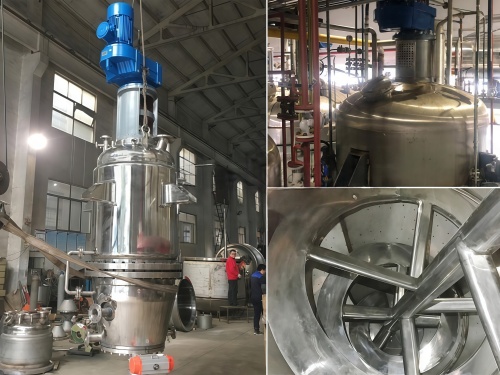
Problems and improvement ideas of the crude silver powder purification, filtration, washing and drying machine
In addition to the problems that have been discovered and solved in the practical process, there are still some unresolved issues that are briefly described as follows
Question 1: The shaft seal of the reaction vessel is not tight. As the integrated machine was purchased and installed later, the pressure design of the reaction vessel was not carried out in the early design stage. As a result, after the later modification, the dynamic seal of the reaction vessel is not tight, which affects the pressurization process of the reaction vessel and has a certain impact on the normal operation of the stirring paddle of the reaction vessel.
Question 2: The liquid discharge pipe of the all-in-one machine is relatively long, with a large vertical drop between the pipe inlet and outlet. Moreover, the liquid outlet of the all-in-one machine is at a low position. Under the effect of the filtrate in the pipe, the resistance at the liquid outlet of the all-in-one machine increases, which is not conducive to the filtration process, prolongs the filtration time, and affects the smooth progress of production. At the same time, extremely fine particles are prone to deposit at the liquid outlet of the all-in-one machine and clog the pipe.
Question 3: The manual discharge valve of the all-in-one machine must be opened and cleaned after each batch of the all-in-one machine is completed. Otherwise, the silver powder adhering to the inner wall will cause the valve to fail to seal strictly, posing a risk of leakage. This step involves a large amount of operation and a small amount of ammonia gas will escape during the operation, resulting in a relatively high local ammonia concentration. This not only causes environmental pollution but also has a certain impact on the on-site operators.
For problems 1 and 2, they need to be addressed through design. The initial idea is to design the reaction vessel, the integrated machine, and the rear liquid pit into a three-level structure of top, middle, and bottom. This way, there will be no significant resistance during the process of discharging liquid from the reaction vessel to the integrated machine and then from the integrated machine to the rear liquid pit. At the same time, it can reduce the required air pressure for production, making the existing reaction vessel meet the usage requirements.
Regarding question 3, as it is necessary to ensure the tightness of the seal, after communicating with the manufacturer for some time, a better valve structure has not yet been found that can effectively solve the problem of tightness while also facilitating opening and closing for cleaning. The initial idea is to add a water pipe near the discharge port and install a high-pressure water gun. After each discharge is completed, The silver powder adhering to the inner walls of the valve pipes is washed clean by spraying water with a high-pressure water gun. After that, the valve can be completely closed, thus solving the situation where screws need to be removed each time and the valve needs to be fully opened to clean the silver powder.
The future improvement directions of the crude silver powder purification, filtration, washing and drying machine
After basically resolving the issues of ammonia gas emission and the moisture content of silver powder, the main directions for improvement are as follows.
(1) Try to minimize the operation time. Currently, the processing time for materials in Reactor 1 of the integrated machine varies between 1.2 and 1.6 hours depending on the material conditions. The processing time for materials in Reactor 2 of the existing plate and frame filter press is approximately 1.5 to 2 hours. According to the current working schedule of our factory, the processing capacity of the integrated machine is slightly insufficient Therefore, it is particularly important to compress the operation time for the integrated machine to process the materials in the reaction kettle to 0.6 to 0.8 hours, making it more in line with the actual production needs.
(2) The entire operation process is fully automated. The integrated machine itself can complete the automation control through Settings. However, to solve the practical problems encountered in production, the control steps of the relevant valves of the reaction vessel have been added to the operation process. Since most of the relevant valves on the reaction vessel are manually controlled valves, they cannot be directly linked with the integrated machine to achieve automatic control. At the same time, the operation process of the integrated machine itself is more complex compared to the traditional plate and frame filter press, and the requirements for precise operation are also higher. If full-process automated control can be achieved, it will be of great help and benefit to reducing errors caused by human operation and ensuring the smooth progress of production.
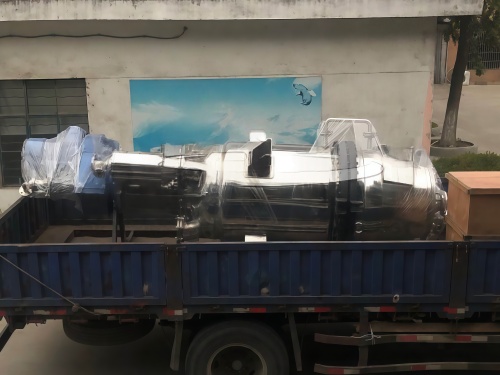

We provide design, research and development, production, and technical services for crystal filtration, washing, and drying equipment, and are committed to undertaking refining and purification projects for fine chemicals, pharmaceuticals and their intermediates, flammable, explosive, and highly toxic special chemicals.
Welcome to contact us!
Tel:13861731823

 备案号:备案号:苏ICP123456789


