Welcome to the official website of Wuxi Shuangrui Machinery Co., Ltd!
Tel:0510-83451680
butylatedhydroxylanisole (BHA) is relatively stable to heat and is not easily destroyed under weakly alkaline conditions, thus it is a good antioxidant. The antioxidant effect of BHA on animal fats is more effective than that on unsaturated vegetable oils, especially for baked goods using animal fats. BHA has a wide range of applications, mainly used in food, oils and fats, and feed, etc. It has been adopted by most industrial countries around the world, including the United States.
Analysis of the Production Process of Food Antioxidants
At present, the main methods for the synthesis and production of BHA are as follows: The first one uses p-hydroxyanisole as the raw material and reacts it with isobutylene or tert-butanol under the action of an acidic catalyst to prepare BHA; The second type uses tert-butylhydroquinone (TBHQ) as the raw material and reacts it with dimethyl sulfate under the action of a catalyst to obtain BHA. The third method is to prepare BHA by reflux in methanol solvent with tert-butylhydroquinone (TBHQ) as the raw material under the action of a complex acid catalyst.
In the first method, due to the high activity of p-hydroxyanisole, a large amount of by-products are produced during the synthesis of BHA, the utilization rate of raw materials is not high, and separation is difficult with high costs, so it is less adopted. In the second method, dimethyl sulfate is highly toxic, causes significant environmental pollution, and has a high cost, which is not conducive to industrial production. In the third method, BHA is produced using TBHQ as the raw material, and both the conversion rate and selectivity are satisfactory. However, the utilization rate of TBHQ is not 100%, and there will always be some raw materials (TBHQ) that do not participate in the reaction or generate by-products during the synthetic production process. It was found through research that the mother liquor after extracting BHA contains unreacted TBHQ, a small amount of oxidation products of TBHQ and diether compounds of TBHQ. Therefore, recycling unused TBHQ can not only reduce environmental pollution but also has certain economic value.
The working principle of the three-in-one filtration, washing and drying
(1) Filtration
The solid-liquid mixture slurry produced by the upstream reaction vessel or crystallization equipment is fed into the tank of the three-in-one equipment, and the solid-liquid mixture is filtered and separated by the pressure difference as the driving force. In practical applications, there are pressure filtration, vacuum filtration, and combined pressure and vacuum filtration forms, etc. Pressurization and filtration use clean compressed air, nitrogen or other inert gases. The specific type of compressed gas should be selected based on the characteristics of the solid-liquid mixture. For instance, if a solid-liquid mixture is prone to oxidation or contains explosive media, compressed air cannot be used; instead, inert gas should be selected. Based on practical experience, in the pharmaceutical industry, a filtration pressure of 0.2 to 0.3MPa is generally sufficient for general products to achieve filtration. In the chemical or food industry, some products require a higher filtration pressure, with some reaching up to 1.0MPa.
(2) Washing
After the filtration process is completed, the next process operation, namely washing, needs to be carried out. The three-in-one equipment tank is equipped with a specially designed spray device, which can evenly distribute the cleaning (washing) liquid in the tank. By turning on the stirring system, the stirring lifting mechanism and the transmission mechanism, the blades can rotate and move up and down axially, ensuring that the materials are thoroughly washed and the impurities adhering to the surface of the grains are removed. The washing liquid used for washing and the number of washes should be determined according to the characteristics of the material and the production process.
(3) Drying
The drying process of the three-in-one equipment can adopt hot air drying or vacuum drying. When using hot air drying or vacuum drying, clean inert gas must be used because dust will be generated during the drying process. It is necessary to consider that the operating environment of the equipment is explosion-proof. At present, the mainstream drying process for the three-in-one equipment is vacuum drying. The main factors influencing the vacuum drying process are vacuum degree, drying time, and the characteristics of the stirring paddle, etc.
The vacuum drying process uses a vacuum system to extract the inert gas inside the tank, reducing the number of gas molecules and isolating it from air. It is mainly suitable for materials that are prone to oxidation and deterioration, as well as for materials where solvents need to be recovered during evaporation and heat-sensitive materials. Under vacuum conditions, the chance of material contamination by bacteria can be reduced or the growth of certain bacteria can be inhibited. Therefore, it is particularly suitable for the drying of sterile materials.
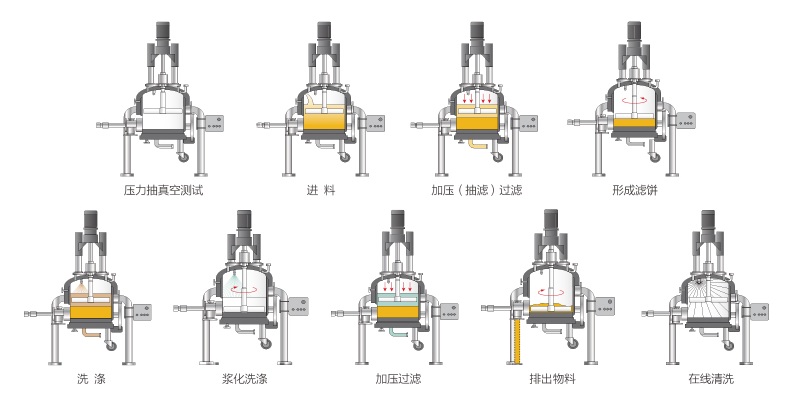
过滤洗涤干燥三合一从叔丁基羟基茴香醚(BHA)生产过程中回收叔丁基对苯二酚(TBHQ)的提纯工艺,该工艺是将生产BHA后所剩的母液浓缩,然后加入有机溶剂溶解,水洗除去残留的金属盐及催化剂酸,然后静置分层去掉水相,收集有机层,再向有机层中加入还原剂加热搅拌回流一段时间,然后浓缩除去有机溶剂,得到TBHQ混合物,再向TBHQ混合物中加入溶剂,加热搅拌溶解,过滤,冷却析晶即回收得到TBHQ。
食品抗氧化剂过滤洗涤干燥三合一提纯工艺操作简便可行,处理时间短,对设备损耗小,对环境不会造成污染;回收的TBHQ纯度高,色泽好,干燥后可以直接用作原料生产BHA,亦可以作为食品添加剂使用。
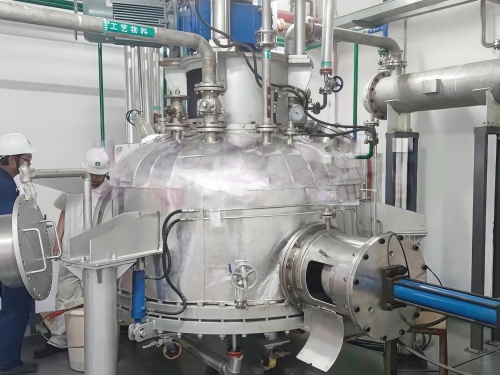
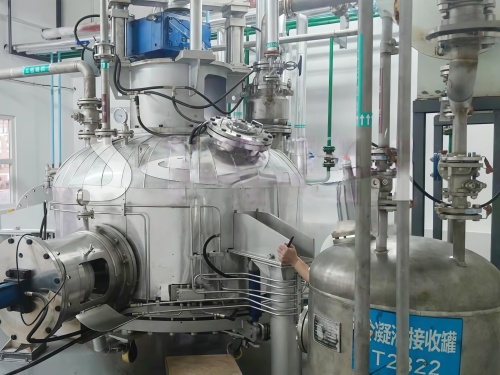

We provide design, research and development, production, and technical services for crystal filtration, washing, and drying equipment, and are committed to undertaking refining and purification projects for fine chemicals, pharmaceuticals and their intermediates, flammable, explosive, and highly toxic special chemicals.
Welcome to contact us!
Tel:13861731823

 备案号:备案号:苏ICP123456789


