Welcome to the official website of Wuxi Shuangrui Machinery Co., Ltd!
Tel:0510-83451680
Powder coating curing agent (abbreviated as haa) is a compound of β -hydroxyalkylamide and an excellent curing agent for weather-resistant polyester. Compared with the tgic curing agent widely used at home and abroad at present, it is non-toxic. Does not irritate the skin; With features such as fast curing speed, the powder coatings made from this product have outstanding outdoor performance and are truly green and environmentally friendly high-quality products.
Polyester curing agent HAA is a type of amide compound containing 2 to 4 hydroxyl functional groups. Due to its hydroxyl group being at the β position, it is highly reactive under the influence of N atoms and is prone to yellowing when heated, especially at high temperatures and for long periods of time. Therefore, the drying process in the later stage of production is crucial to its appearance and quality.
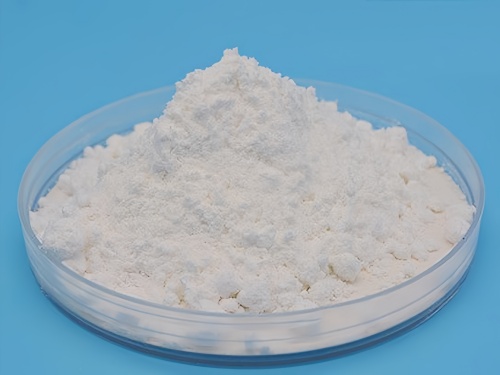
Discussion on the Production Process and Drying Process of Powder Coating Curing Agents
Powder coating curing agent HAA is generally synthesized by the direct reaction of dimethyl adipate and diethanolamine, with methanol as the by-product. After discharge, it is cooled and then enters various drying equipment for drying. To prevent material formation in the reactor, the reaction is incomplete. The majority of the wet material is the product, a small amount is unreacted raw materials or intermediates, and the rest is methanol. Therefore, the subsequent process is not merely a drying process, but a thorough reaction process.
The disadvantage of conventional open dryers is that the circulating air and methanol are prone to form explosive mixtures, posing safety hazards. Moreover, once methanol mixes with air, it is difficult to recover and turns into waste gas, increasing environmental protection costs. Based on this feature, the drying of powder coating curing agent HAA adopts vacuum drying process. When drying under low pressure, the oxygen content is low, which can prevent the oxidation and deterioration of the dried material and can dry flammable and explosive dangerous goods. At the same time, intermittent batch type should be selected to ensure that the material stays in the equipment for a sufficient period of time, such as square vacuum dryers, double-cone rotary vacuum dryers, paddle vacuum dryers, and single-cone vacuum dryers.
Discussion on the Process of Vacuum Dryer for Powder Coating Curing Agent
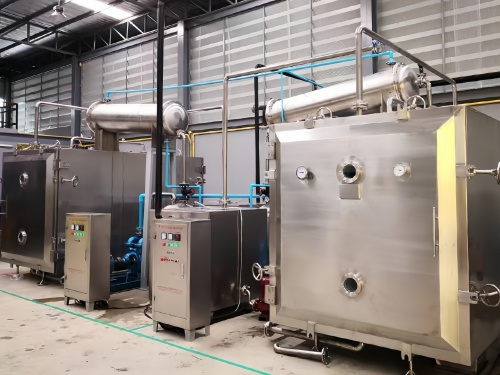
Square vacuum dryer
The square vacuum dryer reduces the boiling point of low moisture content under a pressure lower than normal, removes moisture from materials, and achieves the purpose of low-temperature drying. The vacuum pump is used to extract air and dehumidify, creating a vacuum state inside the working chamber and accelerating the drying speed.
The structure of a vacuum drying oven includes components such as a drying chamber, heating partition, vacuum gauge, pressure gauge, thermometer, safety valve, steam trap, and material tray. Because both loading and discharging are done manually, which is time-consuming and labor-intensive and affects production efficiency, this drying oven was updated to a double-cone vacuum dryer several years ago.
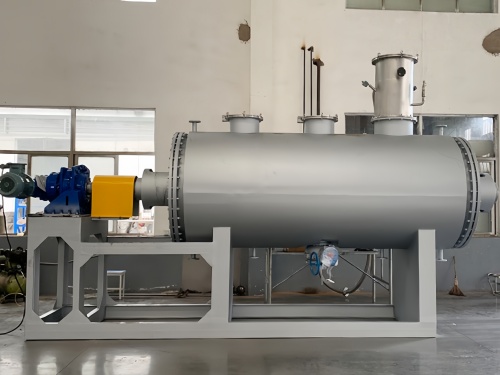
(2) Double-cone rotary vacuum dryer
The double-cone rotary vacuum dryer is a double-conical rotary tank. Inside the tank, under vacuum conditions, steam or hot water is introduced into the jacket for heating. The heat comes into contact with the wet material through the inner wall of the tank. The water vapor evaporated by the wet material after absorbing heat is drawn away through the vacuum pump and vacuum exhaust pipe. Due to the vacuum state inside the tank and the continuous up and down, inside and outside movement of the material caused by the rotation of the tank, the drying speed of the material is accelerated, the drying efficiency is improved, and the purpose of uniform drying is achieved.
When some viscous and heat-sensitive crystalline materials are dried with it, agglomeration may occur, resulting in disadvantages such as longer drying time, lower volumetric production intensity, and difficulty in large-scale production, which greatly limits its application.
(3) Paddle vacuum dryer
The rake vacuum drying equipment uses a jacketed shell to heat the material. Under the stirring of the constantly rotating rake teeth, when the material comes into contact with the shell wall, the surface is constantly renewed. The material to be dried is heated, causing the moisture in it to vaporize. The vaporized moisture vapor is promptly extracted by the vacuum pumping system. The moisture vapor pressure on the surface of the material to be dried is much greater than that in the inner space of the dryer casing, which is conducive to the vaporization of the moisture vapor on the surface of the material to be dried. Due to the stirring effect of the rake teeth, it is conducive to the migration of internal moisture and the movement of molecules in the material to be dried, thus achieving the purpose of drying the material.
After a period of operation and use, the drawbacks of the paddle vacuum dryer are that the support shaft components are prone to wear and leakage, and the HAA is prone to agglomeration. The internal materials are extremely difficult to dry, resulting in a low melting point, excessive volatile matter, low yield, large loss of organic solvents, and high operating costs.
(4) Single-cone vacuum dryer
Commonly used vacuum dryers rely on jacket heating. After the material is heated, the temperature is not uniform enough, the required drying time is relatively long, and the energy consumption is high. In response to the poor performance of heat-sensitive materials with an allowable operating temperature of approximately 60℃, Wuxi Sungrui has developed an improved composite heating vacuum helical ribbon dryer. It forms an automated production process with the upper and lower position equipment, achieving continuous production.
The single-cone vacuum dryer is a new generation of product developed on the basis of the traditional conical mixing drying equipment, in response to the rapid drying and mixing process requirements of the fine chemical industry. The new pulse mixing device makes the mixing faster and more uniform. Adding a heating function to the helical ribbon stirring has greatly improved the drying efficiency.
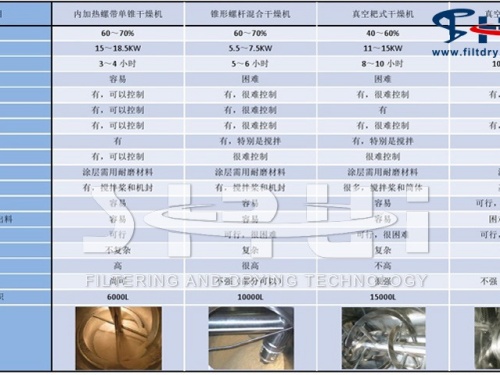
Process Analysis and comparison of Vacuum Drying Machine for Powder Coating Curing agent
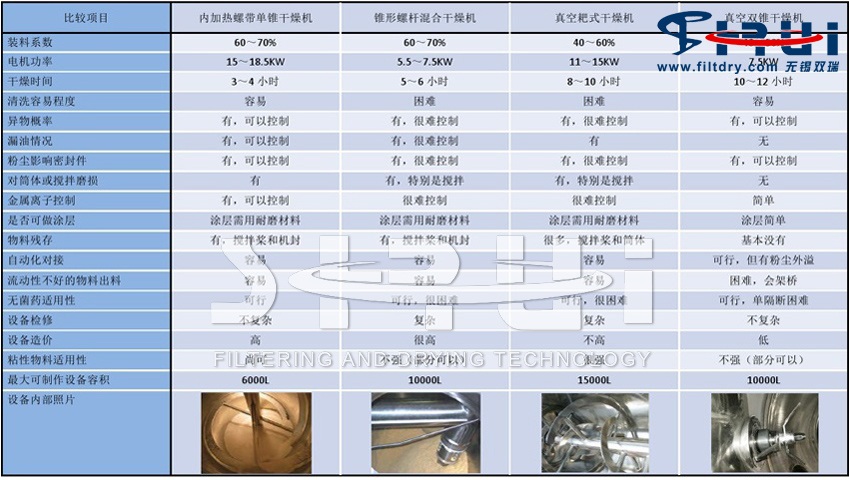
Process improvement of vacuum single cone dryer for Powder coating curing agent
(1) The conical tank adopts a sterile fully sealed structure design. Its internal structure is simple and has no dead corners. It is particularly suitable for the mixing and drying of flammable, explosive, toxic or highly toxic materials, foods, biological products, medicines and other materials that do not allow contamination or have sterile requirements.
(2) The advanced single-cone helical ribbon stirring structure features a high filling rate of over 70%, saving floor space and usage costs
The early drying stage of HAA is the constant-rate drying phase, which takes a short time. Most of the drying time is spent in the later deceleration drying phase, which also promotes further reactions. Therefore, the drying equipment needs to have a strong crushing capacity for the materials, making them fine enough, preferably without any distinction between internal and external, so that the entire drying process is in the constant-rate drying stage and the process of the reduced-rate drying stage is shortened as much as possible.
(3) The cone, head, main shaft and stirring screw ribbon can all be heated by hot water or steam, featuring a large heating area and high heating efficiency. First, add the wet material, heat the shell, the central shaft and the inner heating screw ribbon. By the stirring of the heating screw ribbon, the material is crushed while being driven. As the temperature rises, the material is continuously dried, and finally the ideal product can be obtained.
(4) The new pulse mixing design uses high-pressure nitrogen to impact the materials for rapid mixing, making the mixing of materials faster and more uniform.
(5) A sterile dedicated discharge valve with nitrogen purging, featuring a gas floating seal structure, is simple in design with no dead corners, fully meeting the clean production requirements of GMP and FDA.
(6) Intelligent drying temperature control system
During the drying process, if the temperature is too high, the methanol in the wet material is sufficient to dissolve the HAA on the surface, making the entire material soft and prone to agglomeration. When the temperature is too low, unreacted raw materials or intermediates cannot be transformed into products, or the drying process takes a long time, resulting in reduced efficiency. Therefore, the drying temperature is slowly raised to the reaction temperature to allow the unreacted raw materials to continue reacting, while stirring and crushing to prevent the materials from sticking together and forming lumps.
The new vacuum single cone dryer is highly suitable for the subsequent drying process of powder coating curing agent HAA. Particularly, the internal heating screw ribbon has a gentle stirring and crushing function, which significantly reduces the agglomeration phenomenon and simultaneously enhances the drying efficiency. To meet customers' demands for the appearance and performance of HAA, this equipment can be further improved to achieve a better product appearance. It meets the requirements of practical application.

We provide design, research and development, production, and technical services for crystal filtration, washing, and drying equipment, and are committed to undertaking refining and purification projects for fine chemicals, pharmaceuticals and their intermediates, flammable, explosive, and highly toxic special chemicals.
Welcome to contact us!
Tel:13861731823

 备案号:备案号:苏ICP123456789


