Welcome to the official website of Wuxi Shuangrui Machinery Co., Ltd!
Tel:0510-83451680
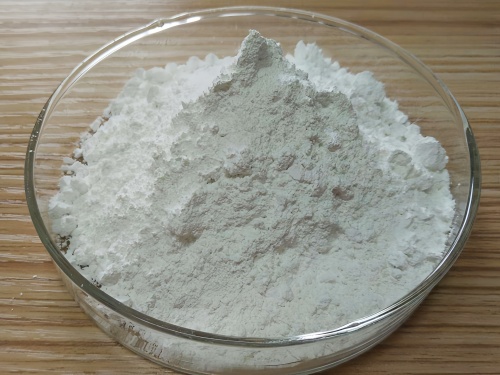
Methyl octabromodiphenyl ether is a flame retardant developed in recent years for the flame retardancy of expanded polystyrene. Due to its environmentally friendly characteristics, it is an excellent alternative to hexabromocyclododecane, which is listed as banned in the Stockholm Convention. Octabromodiphenyl ether industrial products appear as white or light yellow solid powder, with a melting point range of 85 to 105 degrees Celsius. They belong to halogen-based flame retardants, with a bromine content of 68%, and are general-purpose additive flame retardants. They are mainly used for flame retardant modification of polyolefin polymer materials such as polypropylene (PP) and polyethylene (PE).
The production of octabromodiphenyl ether is divided into two steps - etherification and bromination. Etherification is the reaction of tetrabromobisphenol A, sodium hydroxide and methyl chloroallene in a solvent, and the intermediate etheride is obtained through filtration, washing and drying. Bromination is obtained by the addition reaction of ether compounds dissolved in a solvent with bromine. The existing technology involves that after the etherification reaction is completed, the product is centrifuged and filtered by a centrifuge, then rinsed with a solvent, and dried through an air flow dryer or a double-cone vacuum dryer. The intermediate product is then put into the reaction vessel and dissolved with a solvent. This process consists of four steps: centrifugation, washing, drying and dissolving. It is complex and labor-intensive. During the centrifugation process, the solvent will be discharged unorganized, causing environmental pollution. When washing materials, due to the poor washing effect of the materials in the centrifuge and the inability to dry them, the materials will carry some solvents. After the materials dissolve, these solvents will enter the wastewater and cannot be recovered, increasing the production cost.
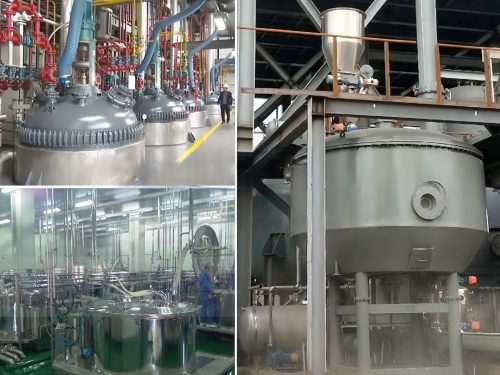
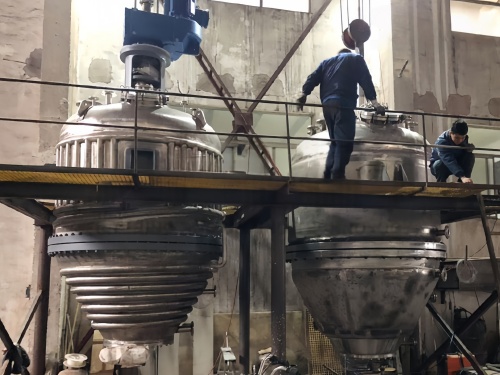
In response to the above deficiencies, Wuxi Sungrui has developed a three-in-one cylindrical and cone-type filtration, washing and drying system. The post-treatment process of octabromodiphenyl ether does not require frequent material transfer, reduces equipment usage, lowers the labor intensity of employees, and enhances work efficiency. It can achieve the recovery of solvents during the process, which not only reduces environmental pollution but also saves the use of solvents and reduces costs.
The working principle of the three-in-one filtration, washing and drying machine dedicated to octabromodiphenyl ether
The three-in-one cylinder-cone reaction, filtration and drying is carried out in the same closed space, where the temperature is controlled by a jacket to conduct pressurized or vacuum reactions of materials. After the reaction is completed, the material is heated and vacuum-concentrated, then cooled to crystallize and precipitate the reaction products. Start the stirring main shaft to apply pressure or vacuum treatment to the solid-liquid mixture after crystallization through the lower conical filter plate. Utilize the pressure difference at both ends of the filter cake and the squeezing effect of the stirring screw belt
Used for solid-liquid separation; Introduce the washing liquid to further remove the reaction liquid in the filter cake and eliminate impurities. At the end of the solid-liquid separation process, a relatively dry solid phase can be obtained. Start the internal heating screw ribbon to heat and vacuum dry the material, and finally obtain the product with a certain degree of dryness.
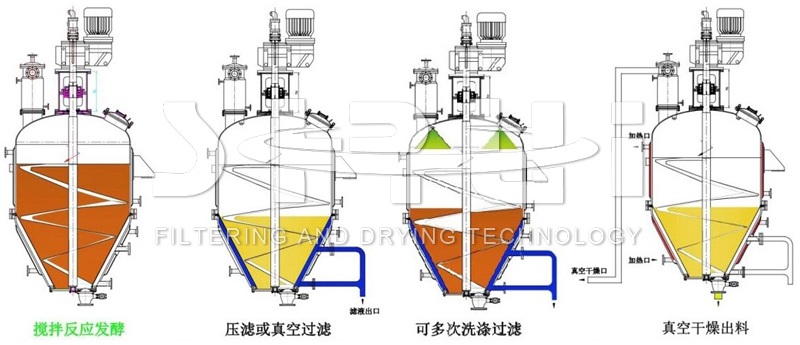
The structure of the three-in-one filtration, washing and drying machine dedicated to octabromodiphenyl ether
The new type of three-in-one filtration and drying machine adopts a cylindrical and conical structure. Heating jackets are set on the cylindrical body and the lower conical body, which can heat or cool the materials. Inside the multi-functional machine, there are hollow shafts and variable-angle and variable-lead hollow spiral stirring devices for stirring and lifting the materials, and the materials are pushed out when discharging. A relatively complex conical filtering device is set in the lower cone. At the bottom of the equipment, there is a specially designed quick discharge device without dead corners or a pneumatic discharge ball valve without dead corners.

We provide design, research and development, production, and technical services for crystal filtration, washing, and drying equipment, and are committed to undertaking refining and purification projects for fine chemicals, pharmaceuticals and their intermediates, flammable, explosive, and highly toxic special chemicals.
Welcome to contact us!
Tel:13861731823

 备案号:备案号:苏ICP123456789


