Welcome to the official website of Wuxi Shuangrui Machinery Co., Ltd!
Tel:0510-83451680
poly(aryl ether ketone) [PAEK] refers to a polymer in which aromatic ethers and aromatic ketones are alternately arranged in the main chain. Polyaryletherketone features a rigid para-phenylene bond structure and a flexible ether bond structure. While maintaining excellent physical and mechanical properties and heat resistance, it also has certain flexibility and toughness. It has excellent comprehensive performance and is easy to process and form. It is a type of widely used thermoplastic special engineering plastic and has a broad market in aerospace, medical devices, nuclear power, petrochemicals, automobiles, home appliances and other fields.
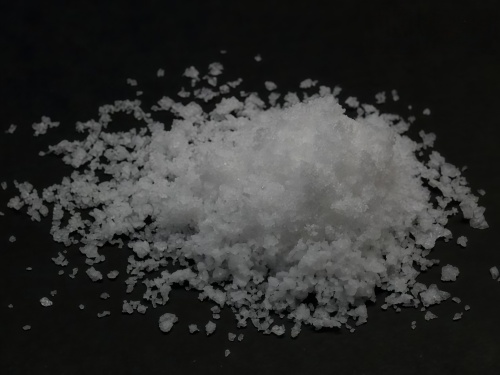
The synthesis of polyaryletherketone usually follows a nucleophilic route, that is, in a non-protonic polar solvent, bisphenol monomers and dihalogenated aromatic ketone monomers undergo condensation polymerization under the action of an alkaline catalyst. This reaction not only generates PAEK polymers but also produces small-molecule halogen salt by-products. At the end of the reaction, the reaction products precipitate in water or lower alcohols. Halogen salts and excess unreacted base catalysts are often encapsulated by PAEK polymers and cannot be well dissolved and removed, requiring further purification.
At present, the post-treatment purification processes of polyaryletherketone prepared by electrophilic reaction routes are mostly complex and cumbersome. Each treatment requires a large amount of solvents, and often requires repeated washing for a long time. Sometimes, high-temperature and high-pressure purification methods are also needed, which have high requirements for equipment. After washing, a large amount of waste liquid is produced, resulting in high investment, low efficiency and significant environmental impact. This thus restricts its further development and application.
(1) First, a mixed solution of formic acid and acetylacetone was used to wash and centrifuge the crude polyaryletherketone to obtain the primary purified product. (Material transfer: Discharge tank → centrifuge, manual open operation)
(2) Then, formic acid solution is used to wash and centrifuge the primary purified product to obtain the secondary purified product. (Material transfer: Centrifuge → purification kettle → centrifuge, manual open operation
(3) Finally, water is used to wash, centrifuge and dry the secondary purified product to obtain the polyaryletherketone purified product. Material transfer: Centrifuge → washing tank → centrifuge → multiple batch dryers, manual open operation
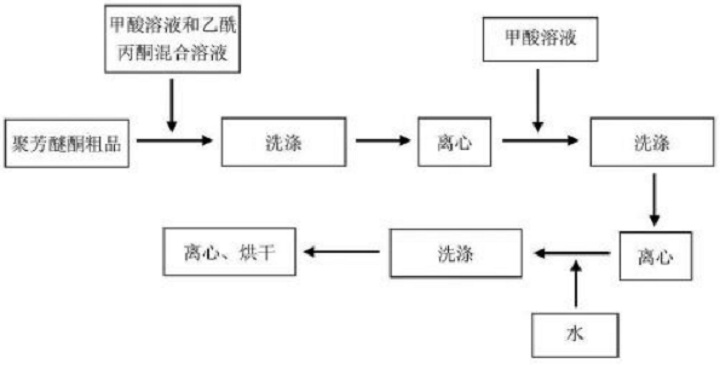
The current crude purification process flow of polyaryletherketone (PAEK) has the following disadvantages:
(1) High safety risk
When using a centrifuge for filtration, since the solvent-containing polymer slurry processed by the centrifuge is flammable and explosive, it is prone to cause combustion and explosion accidents. Moreover, due to its extremely high rotational speed, if operated carelessly or in violation of regulations, it may come into contact with the material inside the rotating centrifuge drum, causing accidents such as amputation of fingers or arms. In addition, drum breakage, drum displacement, and manhole cover flying out caused by various reasons can also lead to serious casualties.
(2) It is impossible to produce in a closed manner and causes significant environmental pollution
Between the steps of filtration, washing, crushing, purification and drying, there is a need for material transfer operations. The level of automation is low, and a large number of personnel are required for each shift. There are occupational disease risks such as solvents and dust during material transfer operations, and there are quality control difficulties such as foreign matter control. The management is difficult. The filter cake has serious defects such as poor washing effect, high labor intensity of manual operation, difficulty in material transfer, and the material is easily affected and contaminated by the transmission components of the equipment and the open working environment.
(3) The purification process is cumbersome and has poor stability
In the traditional purification process of special engineering plastics, the use of dehydrating agents and the polymerization system containing a large amount of salt are environmentally unfriendly and difficult to elute. Therefore, a large amount of organic solvents and deionized water need to be used for repeated washing multiple times to achieve a better purification effect. Therefore, the process is complex, the quality stability is poor, and the production cost is high.
(4) There are numerous devices and the operation is cumbersome, which cannot meet the requirements of large-scale industrial production processes
Filtration, washing and drying are all processed by independent equipment such as centrifuges, washing tanks and dryers. Due to the scattered nature of the equipment, the production process is difficult to control and the degree of automation is low. If the sampling, testing, feeding, replenishment, temperature and pressure are not properly controlled or operated manually, errors and contamination often occur. The difficulty of material transportation among the reaction, filtration and drying devices is even higher. Sometimes, this often leads to the entire set of devices being unable to operate normally or having high labor intensity, long production cycles, high energy consumption and low efficiency, which affects product quality and fails to meet the requirements of large-scale fine chemical production processes.
(5) It occupies a large area and requires high equipment investment
Filtration, multiple washing and filtration, drying and other unit operations are usually operated independently by unit equipment such as crystallization tanks, filter presses or centrifugal filters, washing tanks and dryers. Multiple unit devices form a large long-process device. Materials are conveyed between the devices through pipelines or other means. Each unit operation corresponds to the corresponding unit equipment, and the equipment is distributed. This has significantly increased the factory area for the entire production process and also greatly raised the investment in equipment.
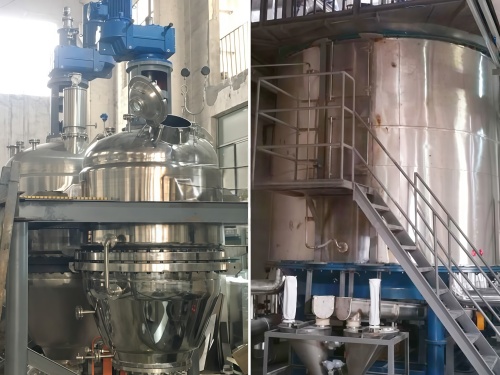
The conical filtration, washing and drying integrated machine developed by Wuxi Shuangrui Machinery and the corresponding washing method (Patent No. (ZL 202022908020.2, ZL 202121331911.4) provided a new process for efficient purification treatment of polyaryletherketone products in the synthesis process. In the post-treatment process, it achieved efficient dehydration and desalination of polymer products containing salt - water - solvent, significantly reducing the content of inorganic salts in the products and minimizing the chance of product contamination. Achieve the purpose of purification. The specific solvent system proposed by the present invention can effectively dissolve oligomers and some inorganic small molecules, and keep the polyaryletherketone resin in a swollen state in the solvent, promoting the mutual movement of polymer chain segments, thereby making it easier for impurity ions mixed in the polyaryletherketone to enter the solvent phase and be purified.
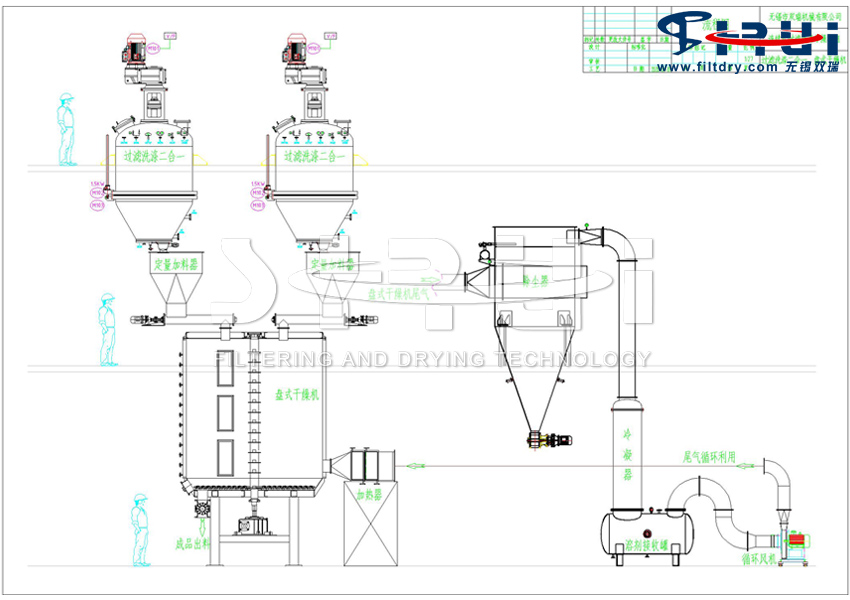
Process steps of the three-in-one dryer for purifying crude polyaryletherketone (PAEK)
The traditional purification process design for polyaryletherketone (PAEK) crude products is unreasonable, and the steps are cumbersome with low efficiency. The continuous refining and purification special engineering plastic filtration, washing and drying unit can solve the problems existing in the separation and purification of polymer materials in the current production. With a fully automated control system, it can ensure the continuity of production, has high efficiency, low energy consumption, is environmentally friendly and green, and is universal and easy to promote.
(1) Cooling and shaping, grinding and crushing (pretreatment processes for the refining and purification of special engineering plastics)
The high-viscosity solution obtained from the polymerization reaction is introduced into an autoclave. The discharge port of this autoclave is equipped with a casting head, a pelletizing knife head and a cooling splash device. By starting the pelletizing knife head and the cooling splash device, the high-viscosity solution is conveyed to the casting head at the discharge port under the action of a pressure pump. Resin micro-particles are obtained successively through pelletizing and cooling by the cooling liquid (large particles will encapsulate salts and oligomers). It affects the effect of refining and purification. Then, the polyarylether nitrile micro-particles obtained through cooling and crystallization are ground and crushed together with the coolant to obtain a relatively uniform powder. Micro-particles are cylindrical particles with a length of 0.25 to 0.5mm and a diameter of 0.2 to 0.45mm.
(2) Solvent extraction to remove oligomers (Material transfer: colloid mill → integrated filtration and washing machine, automatic pipeline transportation, fully enclosed operation)
The resin powder obtained from grinding and crushing is conveyed to the integrated filtration and washing machine. This extraction equipment is equipped with a conical filter screen and an auxiliary heating device. Washing is carried out under stirring conditions. The powder is extracted by a specially designed extraction liquid to remove oligomers, and then filtered in a closed manner to separate the extraction liquid.
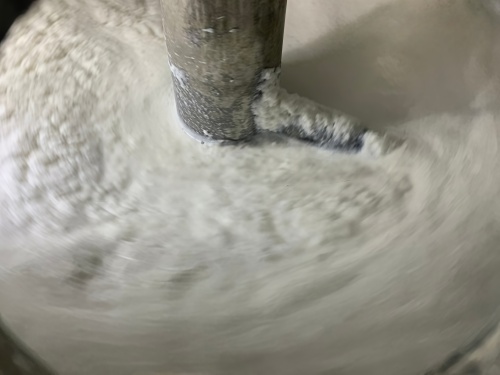
(3) Acid and alkali washing, dissolving salt (no material transfer: filtration and washing integrated machine)
The acid and alkali washing solution is introduced into the integrated filtration and washing machine to re-stir and suspend the filter cake, ensuring that the resin powder can be thoroughly washed. The inorganic salts and other components that have been encapsulated will be released. Stir the slurry evenly and then press the material dry. If one wash is not enough, multiple washes can be carried out. At this time, just repeat the above steps several times. The operation is convenient and the labor intensity is extremely low.
(4) Pure water rinsing and refining (no material transfer: Filtration and washing integrated machine)
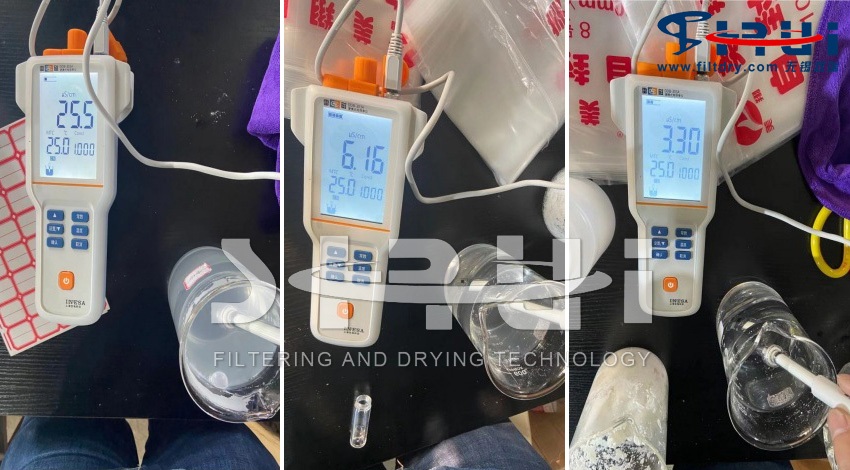
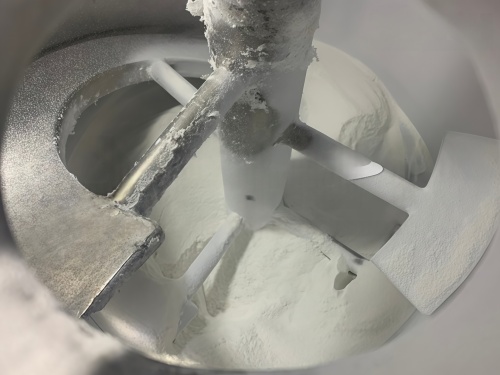
Add pure water to the two-in-one filtration and washing system to carry out pulping and washing, and rinse out the salt impurities in the resin. After the resin is rinsed, pure water is added 3 to 5 times for repeated automatic washing and filtration to remove impurities and by-product inorganic salts on the surface of the resin, and high-purity resin powder is obtained. During filtration, the hollow shaft and hollow screw ribbon can be rotated clockwise (viewed from the top down) to lift the material. At the same time, the hollow screw ribbon can limit the thickness of the filter cake layer while rotating, allowing the material to be filtered under the condition of a thin filter cake layer, thereby increasing the filtration rate.
(5) Closed continuous drying (Material transfer: filtration and washing integrated machine → disc dryer, automatic quantitative conveying, fully closed operation)
The high-purity wet resin obtained through rinsing, desalination and solid-liquid separation is sent into the disc dryer by the chute feeding screw for continuous drying treatment. The dried product is cooled in the disc drying and cooling section and then discharged to the finished product receiving bin to obtain the high-purity resin finished product.
During the drying process, the moisture evaporated enters the condenser from the top of the dryer and condenses into liquid, then flows into the solvent receiving tank. The cooled inert gas is conveyed into the dryer by the circulating fan, absorbs the moisture of the material, and then enters the condenser for re-cooling, forming a closed-loop circulation for utilization.
The polyaryletherketone purified by the filtration, washing and drying machine has a low content of inorganic ion impurities, oligomers and organic impurities, strong electrical insulation and high mechanical strength, making it an extremely excellent engineering plastic. Moreover, the purification process of the conical filtration washing and drying machine can be carried out under fully enclosed negative pressure conditions, causing no pollution to the environment and enabling clean production.
Wuxi Sunray is committed to promoting technological innovation in crystallization, filtration, washing and drying equipment, and values the full trust given by customers. Intellectual property rights are the common lifeline of Shuangrui Machinery and its customers. At Wuxi Sunray, we adhere to the foundation of our business as honesty and dedication, and maintain a zero-tolerance policy towards infringement. We resolutely crack down on any criminal acts that infringe upon intellectual property rights. This is the supreme responsibility, obligation and commitment of Wuxi Sunray. We must sincerely repay our customers' trust and completely eliminate any infringement.

We provide design, research and development, production, and technical services for crystal filtration, washing, and drying equipment, and are committed to undertaking refining and purification projects for fine chemicals, pharmaceuticals and their intermediates, flammable, explosive, and highly toxic special chemicals.
Welcome to contact us!
Tel:13861731823

 备案号:备案号:苏ICP123456789


