Welcome to the official website of Wuxi Shuangrui Machinery Co., Ltd!
Tel:0510-83451680
Polyphenylene oxide (PPO) resin is a thermoplastic resin developed by General Electric Company of the United States in the mid-1980s and belongs to the five major general-purpose engineering plastics. It has excellent physical and mechanical properties, heat resistance and electrical insulation. It has low moisture absorption, high strength, good dimensional stability and the best creep resistance at high temperatures among all thermoplastic engineering plastics. At present, blending modification is an important modification measure for polyphenylene ether. Blending modification has excellent comprehensive performance and is widely used in many fields such as the automotive industry, electronics and electrical appliances, office machinery, precision machinery, and textile equipment.
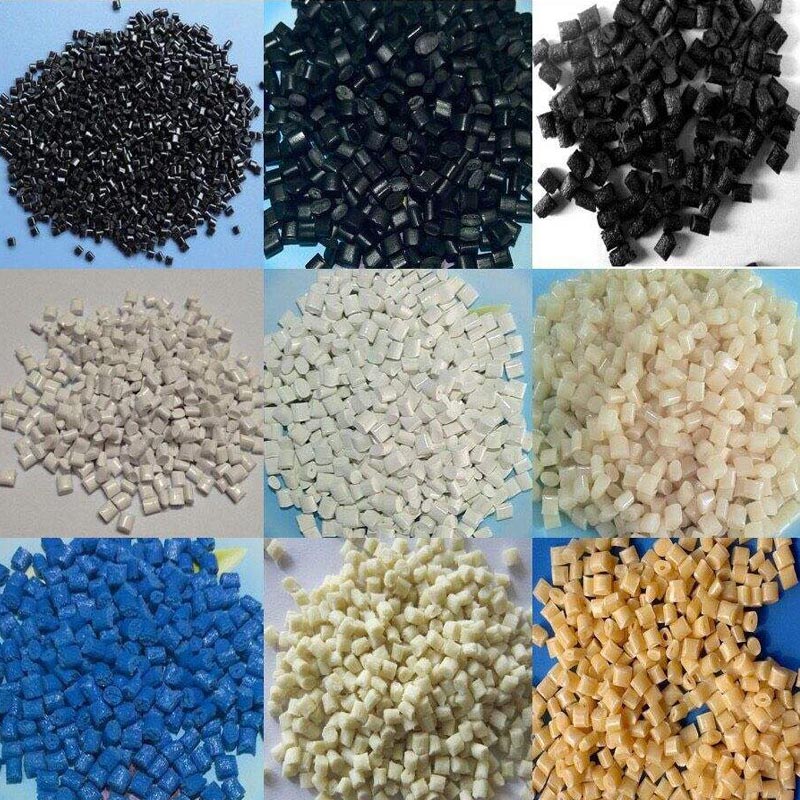
Especially in the high-performance circuit board industry, polyphenylene ether has considerable application prospects. As a blend component, it effectively improves the defects exposed by common circuit board substrates such as epoxy and phenolic resins, including poor dielectric properties, poor heat resistance, high thermal expansion rate, and poor moisture resistance. Especially, low-molecular-weight resins can not only enhance the wettability of the resin, achieve room-temperature impregnation, and greatly improve the fluidity of the resin during molding, but also do not require the pre-functionalization of raw materials. When smaller molecular weight is used to modify epoxy resin, it can be relatively quickly dissolved in liquid epoxy resin at a certain temperature to obtain a system with appropriate viscosity, improving the impregnation property of reinforcing materials and enhancing the fluidity of bonded sheets. Therefore, a high-content epoxy resin system with good processing performance can be achieved. The heat resistance, dielectric properties and fracture toughness of the cured system are better. Therefore, the preparation of high-purity and low-molecular-weight polyphenylene ether has very important practical significance.
Analysis of the current filtration and washing processes of Polyphenylene Oxide (PPO) resin
Before the polyphenylene ether precipitates and enters the dryer, it needs to be filtered and washed. The process requirements are as follows: ① Reduce the total volatile matter in the filter cake to less than 60% of the total weight of the filter cake, and reduce the good solvent (such as toluene) to less than 10% of the total weight of the filter cake. Excessive good solvent content will cause the polyphenylene ether to adhere to the inner wall of the dryer during the drying process, resulting in a decrease in drying efficiency and even damage to the dryer. ② Try to minimize the breakage of particles during filtration and washing, especially the proportion of particles smaller than 100μm should be controlled within 15%. Excessive fine powder will increase the possibility of dust pollution and dust explosion in downstream processing.
The existing technology usually follows the post-treatment process of polyphenylene ether as follows: solid-liquid separation (filtration)→ dispersion and cleaning (usually by stirring)→ secondary solid-liquid separation (re-filtration)→ drying and other steps. In most cases, at least 2 to 3 solid-liquid separations (filtration), 1 to 2 dispersion and cleaning processes, and 1 to 2 drying processes are required. This process requires a large amount of equipment, has a long processing time (dispersion time >10 minutes), low efficiency and a high particle breakage rate. It is difficult to ensure that the particle breakage rate does not increase while minimizing the concentration of good solvents (such as toluene) as much as possible.
In addition, to reduce the content of good solvents in the filter cake, it is often achieved by increasing the frequency of cleaning, increasing the amount of methanol used, extending the cleaning time, and increasing the intensity of stirring. The ensuing problems are: long material processing time, low efficiency, increased crushing rate, and high fine powder rate. Therefore, the existing technical process has a contradiction between reducing the concentration of good solvent (toluene) and lowering the content of fine particles in polyphenylene ether.
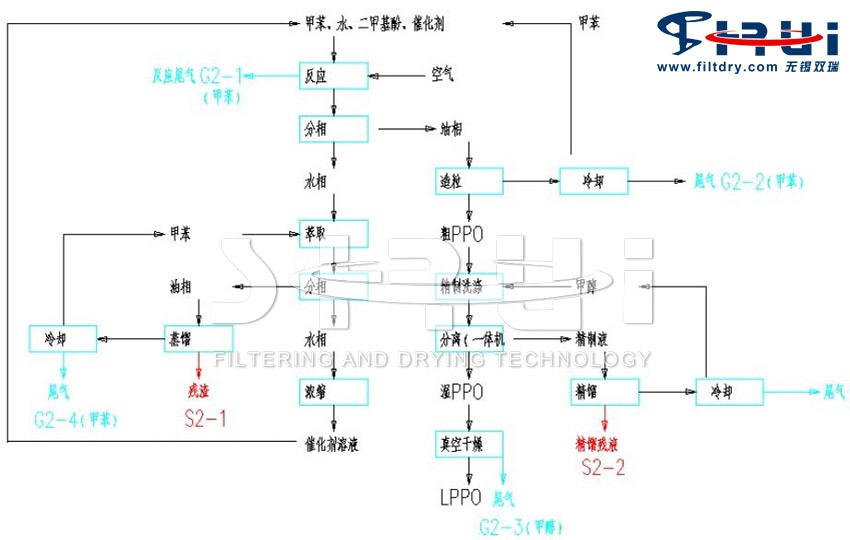
Analysis of the Conical Two-in-one Filter in the pressure Filtration and Washing process Technology of Polyphenylene Oxide PPO resin
The current process is fragmented and uses a large number of devices. The production process that is carried out separately by multiple devices can be combined into a conical two-in-one filter, and then the production can be carried out step by step. That is, solid-liquid separation is carried out first in one device, followed by multiple dispersion and cleaning, and finally drying. During the dispersion cleaning process, avoid the problem of excessive powdering of materials caused by stirring to enhance mass transfer, and at the same time, strengthen the continuity of production. The entire production process involves no secondary transfer of materials, thus saving the time wasted due to material transfer. Under normal production conditions, the time required for material transfer is not long. However, in actual production, the problem of material clogging of pipelines always occurs, which prolongs the entire production cycle.
Solid-liquid separation process
The solid-liquid separation of the slurry liquid was carried out to obtain polyphenylene ether filter cake. This separation process adopted the pressure filtration method. In the pressure filtration process of solid-liquid separation, the boiling of low-boiling-point solvents can be avoided. The thickness of the polyphenylene ether filter cake is controlled at 10 to 50mm, and a thin filter cake filtration method is adopted to achieve high-efficiency filtration.
(2) Cleaning process
Spray the filter cake obtained from the solid-liquid separation process with the cleaning solution, and at the same time remove the cleaning solution after spraying. By controlling the amount of cleaning solution, the temperature of the cleaning solution and the cleaning pressure, a better washing effect can be further achieved.
(3) Pre-drying
The pre-drying process can adopt conventional drying methods, such as gas purging drying or spin-drying, to remove the solvent on the surface of the filter cake. The gas purging drying method, such as using inert gas purging drying, sets the temperature of the drying gas between 1 and 200℃.
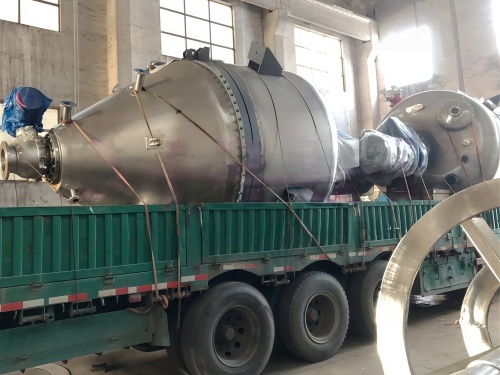
The conical two-in-one filter integrates the production process of polyphenylene oxide PPO resin filtration and washing, simplifies pipeline setting, reduces the difficulty of high-molecular polymer refining and purification process, improves product purity, and is conducive to improving the stability of product quality. And it enables the recycling of solvents, catalysts, etc., as well as achieves energy conservation and environmental friendliness.
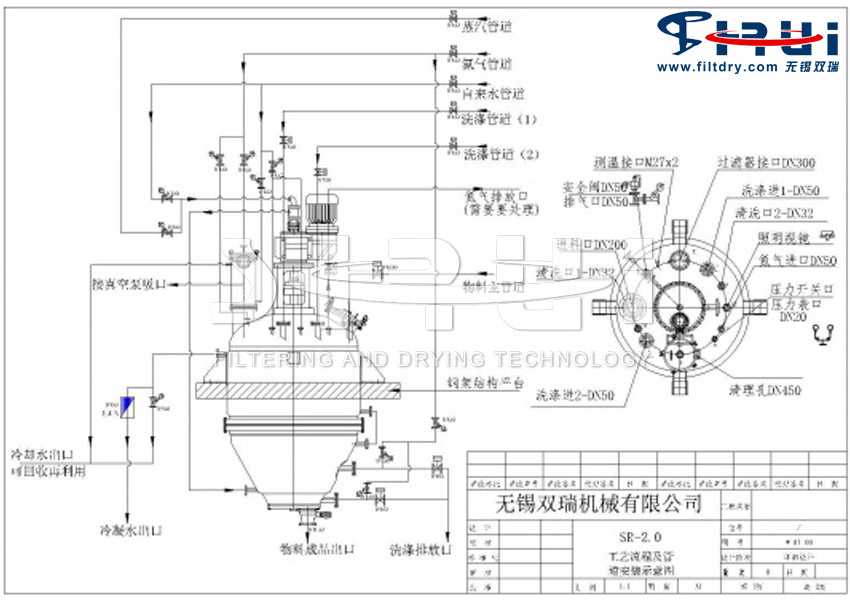
The working principle of the two-in-one pressure filtration and washing of polyphenylene oxide PPO resin
The conical two-in-one filter is equipped with multiple layers of perforated plates and filter media stacked inside the cone or cylinder to form a filtering device. Inside, there is a stirring shaft and a variable-angle and variable-lead spiral stirring device. During the filtering process, it performs stirring, lifting and scraping operations on the materials, and automatically pushes out the filter cake during unloading. This machine can perform vacuum filtration or pressure filtration. During the filtration process, the scraper inside the machine constantly scrapes off the filter cake on the filter screen, allowing the material to be filtered under the condition of a thin layer of filter cake, with a very high filtration rate.
If the material needs to be washed, the slurry can first be filtered dry in the machine, then the washing liquid can be added. By using the rotation and stirring of the scraper, agitator and squeezing screw inside the machine, the filter cake can be re-slurry. At this time, the re-slurry material can be filtered into a filter cake by applying pressure or vacuuming. By repeatedly filtering the slurry in this way, the material can be thoroughly washed, and finally all the filter cake can be extruded out of the machine.
(1) Pressure filtration or vacuum filtration
The solid-liquid mixture slurry produced by the upstream reaction vessel or crystallization equipment is fed into the tank of the two-in-one equipment. Open the filtrate outlet at the bottom and introduce compressed air or nitrogen and other gases into the equipment to pressurize and filter the solid-liquid mixture that has undergone the reaction until the material inside the machine is dried. Vacuum can also be drawn at the filtrate outlet to perform vacuum filtration on the material until the filtrate is completely drained. During filtration, the hollow shaft and hollow screw ribbon can be rotated clockwise (viewed from the top down) to lift the material. At the same time, the hollow screw ribbon can limit the thickness of the filter cake layer while rotating, allowing the material to be filtered under the condition of a thin filter cake layer, thereby increasing the filtration rate. For materials that are easy to filter, there is no need to stir during filtration; just filter the materials dry directly.
(2) It can be washed and filtered multiple times
Some materials need to be washed multiple times after filtration. The reaction filtration and drying multi-functional machine is an ideal device for repeated and multiple washes of materials. After the material is pressed dry in the machine, washing liquid can be added to the top washing liquid inlet. Then, through the stirring of the hollow shaft and hollow screw ribbon, the filter cake is uniformly re-pulped. After the re-pulping is stirred evenly, the material is pressed dry again. If one wash is not enough, multiple washes can be carried out. At this time, just repeat the above steps several times. The operation is convenient and the labor intensity is extremely low.
The washing of materials by the above-mentioned method is called the intermittent washing method. Since the material is pressed dry each time and then the washing liquid is added for washing, although the valve is opened and closed more frequently during operation, less washing liquid is used. This machine can also continuously wash materials. That is, the washing liquid is continuously pumped in by a pump or other methods, and the pressure of the washing liquid is used for filtration. The hollow shaft and hollow screw ribbon constantly stir, and the filtrate is continuously discharged from the filtrate outlet until the washing requirements are met. Finally, the filter cake is dried by pressing. This continuous washing method usually requires more washing solution than intermittent washing, but it is more convenient to operate.
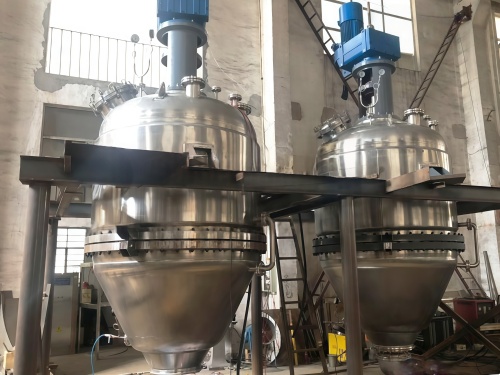
Photo of the two-in-one equipment for pressure filtration and washing of polyphenylene oxide PPO resin
Wuxi Sunray is committed to promoting technological innovation in crystallization, filtration, washing and drying equipment, and values the full trust given by customers. Intellectual property rights are the common lifeline of Shuangrui Machinery and its customers. At Wuxi Sunray, we adhere to the foundation of our business as honesty and dedication, and maintain a zero-tolerance policy towards infringement. We resolutely crack down on any criminal acts that infringe upon intellectual property rights. This is the supreme responsibility, obligation and commitment of Wuxi Sunray. We must sincerely repay our customers' trust and completely eliminate any infringement.

We provide design, research and development, production, and technical services for crystal filtration, washing, and drying equipment, and are committed to undertaking refining and purification projects for fine chemicals, pharmaceuticals and their intermediates, flammable, explosive, and highly toxic special chemicals.
Welcome to contact us!
Tel:13861731823

 备案号:备案号:苏ICP123456789


